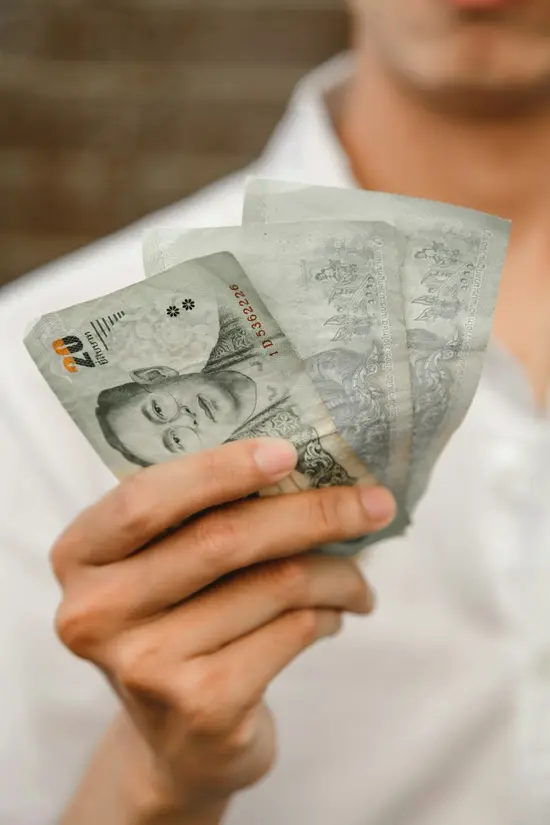
Thailand's currency in 30 seconds
The currency of Thailand is the Thai Baht (symbol ฿, currency code THB), divided into 100 Satang. One US dollar is approximately 33.5 Baht and one British pound approximately 44.5 Baht, so 1,000 Baht is roughly equivalent to 30 US dollars or 22 British pounds. Outside of hotels and shopping malls, cash is still the primary form of payment in Thailand. Street food, taxis, markets, and temple entrances are cash-only. Therefore, budget 1,000–2,000 Baht per day in cash and use a card for hotels, shopping malls, and chain restaurants.
ATMs and currency exchange offices are available in every tourist area. Major Thai banks charge 250 baht per withdrawal with a foreign Visa card and 350 baht with a Mastercard. Therefore, only take enough cash for the first few days, not for your entire trip, withdraw larger amounts, and always choose to be billed in baht, never in your home currency. This guide explains the banknotes and coins, their prices, how much cash you should carry, and warns you about potential pitfalls when exchanging money.
Key facts
The exchange rate is approximately 33.5 Baht to 1 US Dollar and 44.5 Baht to 1 Pound.
For a quick rough calculation: 100 baht is approximately 3 US dollars and 1,000 baht is approximately 30 US dollars (or 22 pounds). One euro is approximately 37.4 baht. The following table shows the amounts you will actually be dealing with.
The fee for ATM withdrawals is 250 Baht when paying with Visa and 350 Baht when paying with Mastercard.
Bangkok Bank, Kasikorn, SCB, and Krungsri charge 250 baht (approximately US$7.50) for foreign Visa cards and 350 baht (approximately US$10.50) for foreign Mastercards per withdrawal, regardless of the amount. Therefore, it's best to withdraw the maximum amount (usually 20,000–30,000 baht) rather than smaller amounts. If you have both cards, use the Visa card. Using a card from Wise, Revolut, or Charles Schwab will also help you avoid your own bank's fees.
Always pay in baht, never in dollars.
If a card terminal or ATM offers you the option to pay in your home currency (dynamic currency conversion), decline. The built-in markup is 3–8%. Always choose THB.
Bring 1,000–2,000 baht in cash every day.
Street food (40–80 baht per meal), songthaews, tuk-tuks, market stalls, laundromats, and most temple fees can only be paid in cash. Keep 1,000–2,000 baht in small bills on hand daily (10,000–15,000 baht will last a week). Exchange 1,000-baht notes well in advance, as they are difficult to spend at street stalls.
Proof of sufficient financial resources can amount to 10,000 or 20,000 Baht per person.
Immigration officials may require proof of sufficient funds from travelers. The Tourism Authority of Thailand (TAT) states 10,000 baht per person (20,000 baht per family) for a visa on arrival, transit, and some visa-free entries, and 20,000 baht (40,000 baht per family) for a tourist visa. However, several websites of the Royal Thai Embassy state 20,000 baht per person for visa exemption. Carrying 20,000 baht or the equivalent in cash will ensure you meet the requirement. The immigration officer will decide whether to ask for proof of funds.
Thai Baht banknotes and coins
There are banknotes in five denominations, each with its own color: 20 baht (green), 50 baht (blue), 100 baht (red), 500 baht (purple), and 1,000 baht (brown/gray). All bear the image of the king, which is important in practice, as Thai law considers damaging or trampling money an insult to the monarchy. Therefore, never step on a fallen banknote, lest it blow away.
The banknotes currently in circulation belong to Series 17 of the Bank of Thailand. They were first issued on July 28, 2018, and feature King Vajiralongkorn (Rama X) on the front and a previous king on the back: Rama I and Rama II on the 20-baht note, and Rama IX and Rama X on the 1,000-baht note. The 20-baht note was converted to polymer on March 24, 2022, followed by the 50- and 100-baht polymer banknotes on November 21, 2025. These feature a transparent window that allows you to see through them from both sides. The paper versions and older series featuring King Bhumibol (Rama IX) remain legal tender. Therefore, you are likely to find two or three different designs of the same banknote in your change.
Coins are available in denominations of 1, 2, 5, and 10 baht, as well as 25 and 50 satang, which are mainly used as change in supermarkets. The most common coins are 20, 100, and 10 baht. ATMs dispense 1000-baht coins, so it's advisable to exchange these early at 7-Eleven stores, supermarkets, or shopping malls and keep the smaller coins for street food and transportation.
A brief history of the Baht
The baht was originally a unit of weight, approximately 15 grams of silver, and foreigners called the coin a tical, the name printed in English on Thai banknotes until the 1920s. The decimal system of 100 satang per baht, developed by Prince Jayanta Mongkol, was introduced in 1897 with the first satang coins and completely replaced the old units by 1910.
From 1984, the baht was pegged to the US dollar (approximately 25 baht per US dollar). On July 2, 1997, the exchange rate was floated, causing its value to roughly halve and fall to 56 baht per dollar in January 1998 – a collapse that triggered the Asian financial crisis. Since then, the baht has been freely floating, which is why the information in this guide is only a rough estimate and the exchange rate on the stock market is the definitive rate.
Conversion of Baht to Dollars and Pounds
The exchange rate is approximately 33.5 baht to 1 US dollar and 44.5 baht to 1 pound (XE mid-market rate). ATMs and card networks pay slightly less, so these rates should be considered optimal.
How things cost in Baht
The prices correspond to our full Thailand travel cost index at /thailand-travel-costs, which includes daily budgets by region and travel style.
How much cash should you take to Thailand?
Budget 1,000–2,000 baht (US$30–60) per person per day in cash for expenses that can only be paid in cash (street food, markets, tuk-tuks, songthaews, laundry, temple entrance fees). Pay for hotels, shopping malls, chain restaurants, and excursions by card. For a week, this equates to 10,000–15,000 baht. You don't need to have the entire amount with you upon arrival. Exchanging 2,000–3,000 baht at the airport will cover taxis and your first meal. Currency exchange offices and ATMs in the city generally offer better rates than those you'd find at home.
Two official figures are important. First, immigration officials may require arriving visitors to show proof of sufficient funds. The Tourism Authority of Thailand (TAT), in its July 2026 reminder, states 10,000 baht per person (20,000 baht per family) for a visa on arrival, transit, and some visa-free entries, and 20,000 baht (40,000 baht per family) for a tourist visa. However, the Royal Thai Embassy in Washington and other embassy websites state 20,000 baht per person (40,000 baht per family) for visa exemption. Therefore, 20,000 baht or the equivalent in cash is the safest option. Baht, foreign currency, or proof of payment are all equally acceptable. Children under 12 are exempt from visa requirements. The immigration officer will decide whether to ask for proof of funds.
Secondly, customs regulations. There are no import restrictions on baht or foreign currency, but foreign cash exceeding US$20,000 must be declared. When departing, you may carry 50,000 baht in banknotes, or up to 2 million baht if traveling to Vietnam, the Chinese province of Yunnan, or a country bordering Thailand. Amounts exceeding 450,000 baht must be declared. Neither of these is a reason to carry your entire travel budget in cash. Take only what you need for a few days and use a low-fee travel card at ATMs.
Where to exchange money in Thailand (and where not to)
The best exchange rates in the country can be found at specialized exchange bureau chains like SuperRich (the green and orange ones), Vasu, and SIA Money Exchange in Bangkok. They are generally a few percent better than banks and airport counters. Bring clean, undamaged bills, as torn or heavily worn foreign notes will not be accepted. $100 bills often offer a slightly better rate than smaller denominations.
Don't exchange your money at home before you fly. US and European banks offer worse exchange rates for Thai baht than in Thailand itself. Exchange 2,000–3,000 baht at the airport for a taxi and your first meal, and take care of the rest once you're in town. Hotels offer the worst rates, followed by the exchange bureaus at the airport.
The most common alternative for travelers who don't need an exchange rate is to pay by card wherever possible and withdraw baht from ATMs using a low-fee travel card. Schwab's debit card is a Visa card, so Thai ATMs charge 250 baht, which Schwab refunds, making withdrawals almost free. Wise offers the mid-market rate and doesn't charge for the first $250 (or £250) of withdrawals per month, after which it's $1.95 plus 1.95% in the US or 2.69% in the UK. Revolut also offers a fair rate with a monthly limit. Regardless of the card, the Thai bank's fee of 250–350 baht still applies at ATMs, so the Visa rule saves 100 baht per withdrawal compared to Mastercard.
Thai Baht for travelers from Great Britain
One pound is roughly equivalent to 44.5 baht, so 1,000 baht is approximately £22. The ATM withdrawal fee is 250 baht, which is about £5.60 (£7.90 with Mastercard). Should you buy baht in the UK or in Thailand? In Thailand, for the most part. Exchange bureaus in the city, such as SuperRich, offer better rates than you'd find at home. So either order a small amount online for collection before your flight or exchange 2,000–3,000 baht at the airport and the rest in town or at an ATM. If you're bringing pounds sterling to exchange, use clean £50 or £20 notes issued by the Bank of England, as Scottish and Northern Irish banknotes are often not accepted.
Most British banking apps work well in Thailand, though with varying limits. Starling offers free withdrawals abroad up to £300 per day. Chase UK is also free, with a daily withdrawal limit of £500 and a monthly limit of £1,500. Monzo allows free withdrawals of up to £200 every 30 days outside the EEA, after which a 3% fee applies. Wise UK offers £250 per month free, followed by a 2.69% fee. None of these banks waive the Thai banks' ATM withdrawal fee of 250–350 baht, so it's recommended to withdraw larger amounts using each card.
Card payments, mobile payments & tips
Visa and Mastercard are accepted at hotels, shopping malls, restaurant chains, supermarkets, and most tour operators. American Express is less widely accepted. Thailand's own QR payment system (PromptPay) is ubiquitous and operates through Thai bank accounts; however, visitors can now also scan QR codes themselves. TAGTHAi Easy Pay links the TAGTHAi app to the Kasikorn Bank's "Pay & Tour" prepaid card. This card can be obtained and loaded for free at the KBank exchange counter in Suvarnabhumi Airport. It can then be used to pay for any Thai QR code; it functions like a Visa card. In Bangkok, MRT entrances can be opened with a contactless Visa or Mastercard, but a separate ticket or Rabbit card is still required for the BTS Skytrain. Outside of cities, it's advisable not to rely on the usual payment methods.
Tipping is appreciated but not mandatory. Therefore, round up taxi fares, tip 20–50 baht in simple restaurants, 5–10% in more upscale restaurants if a service charge isn't already included (check the bill, as a 10% charge is often added), and 50–100 baht per day for room cleaning at hotels or a helpful driver. No one will ask you for a tip, and no one will refuse one.
The three most important rules are: (1) Pay in Baht, never in your home currency; (2) withdraw large amounts infrequently, as the ATM fee of 250–350 Baht is the same whether you withdraw 1,000 or 25,000 Baht; (3) use a Visa card instead of a Mastercard at the ATM.
Finances sorted? Then plan the rest of the trip.
Frequently Asked Questions
Frequently asked questions about the Thai Baht, the currency of Thailand.
The Thai baht (symbol ฿, ISO code THB) is divided into 100 satang. Banknotes are issued in denominations of 20, 50, 100, 500, and 1,000 baht (the 20, 50, and 100 baht notes are now also available in polymer); coins in denominations of 1, 2, 5, and 10 baht, as well as in smaller satang pieces. One US dollar is approximately 33.5 baht, and one pound is approximately 44.5 baht.
Approximately 3,350 baht is enough for 2-3 days of comfortable travel on a budget. This covers one night in a guesthouse, three meals at a street stall or in a local restaurant, public transport, and a massage, with some money left over. At a moderate pace, this is roughly equivalent to a full day.
Approximately 30 US dollars or 22 pounds. In Thailand, this will buy you 12–25 street food dishes for 40–80 baht, two to four one-hour Thai massages for 250–400 baht, or an overnight stay in a budget hotel (usually 500–1,500 baht). It's also the banknote dispensed from ATMs, so you should exchange it in advance.
For backpackers, this is okay, but not quite in the mid-price range. According to the website's budget information, a week backpacking-style costs around US$210–300, and in the mid-price range, US$550–700, not including flights. Two weeks would cost US$420–600 or US$1,100–1,400, respectively. US$1,000 (approximately 33,500 baht) is enough for two weeks, covering guesthouses, street food, bus fares, and a few tours, with some money left over. In the mid-price range, however, this would only cover 10–12 days.
Budget 1,000–2,000 baht (US$30–60) per person per day for cash payments (street food, markets, tuk-tuks, temple entrance fees), so 10,000–15,000 baht for a week, including hotels and tours paid by card. Only take as much cash as you need for the first few days and withdraw it from ATMs (250 baht per withdrawal with Visa, 350 baht with Mastercard, so a maximum of 20,000–30,000 baht) or from a currency exchange in town, rather than carrying your entire budget.
Not necessarily in cash, but the immigration authorities may request proof of sufficient funds. The Tourism Authority of Thailand (TAT) specifies 10,000 baht per person (20,000 baht per family) for a visa on arrival, transit, and some visa-free entries, and 20,000 baht (40,000 baht per family) for a tourist visa. Baht, the equivalent in a foreign currency, or proof of payment are accepted. Children under 12 are exempt from the fee. The embassy website mentions cash or its equivalent, so having 20,000 baht in cash is the easiest way to ensure you have sufficient funds.
Possibly, and official sources contradict each other. The Tourism Authority of Thailand (TAT), in its July 2026 memorandum, states 20,000 baht per person (40,000 baht per family) for tourist visas and 10,000 baht for certain visa-free entries, while the Royal Thai Embassy in Washington and other embassy websites state 20,000 baht per person for visa exemptions, which most Western passport holders utilize. The official decides whether to request this amount, and having 20,000 baht or the equivalent in another currency will cover you in either case.
You can bring as much cash as you like, however, foreign cash amounts exceeding US$20,000 must be declared to customs upon arrival. When leaving Thailand, you may take 50,000 baht in banknotes, or up to 2 million baht if you are traveling to Vietnam, the Chinese province of Yunnan, or a country bordering Thailand. Amounts exceeding 450,000 baht must be declared.
In Thailand, city exchange bureaus like SuperRich offer better baht rates than British banks and exchange offices. Therefore, buy only a small amount at home (or exchange 2,000–3,000 baht at the airport) and exchange the rest in town or withdraw cash from an ATM using a fee-free card like Starling, Chase, or Wise. Bring Bank of England banknotes, as Scottish and Northern Irish notes are often not accepted.
THB. This is the ISO 4217 code for the Thai Baht, used by banks, card terminals, and exchange bureaus; "BHT" is a common misspelling with no official meaning. The symbol is ฿, and Thai prices are quoted as either ฿100 or 100 บาท.
That goes a long way, as 3,350 baht far exceeds the average Thai daily wage and covers three full day trips for backpackers. For travelers, 100 US dollars per day is sufficient for a solid trip in the mid-price range (private hotel, restaurant meals, taxis, and one paid activity) – except on the most expensive islands.
No. Thailand is not a dollar economy. Apart from visa fees at land borders and a few overpriced tourist attractions, everything is priced and paid for in baht. Exchange your dollars (clean 100-dollar bills offer the best rate) or withdraw baht from ATMs.
Yes, carry 1,000–2,000 baht in small bills daily. Card payments are accepted at hotels, shopping malls, and restaurant chains, but street food stalls, markets, tuk-tuks, songthaews, small shops, laundromats, and most temple entrances only accept cash. Immigration officials may also require arriving visitors to pay 10,000–20,000 baht per person. Cash in baht or another currency is accepted on all official websites.
Two options are equally viable: (1) Cash withdrawals from ATMs using a fee-free travel credit card (Wise, Revolut, Charles Schwab), ideally Visa, withdrawing the maximum amount of 20,000–30,000 baht so that the ATM fee of 250–350 baht remains at approximately 1%; (2) Exchanging clean US$100 bills at a SuperRich or similar exchange bureau in town. Exchange bureaus at the airport, hotels, and purchasing baht in your home country will each be a few percent more expensive.
Where to stay in Thailand
Compare prices on different trusted booking sites for the destinations listed in this travel guide.
Compare prices on Booking.com
We may receive a commission for bookings made through these links – this will not incur any additional costs for you. Learn more.
You might also like this
Best time to travel to Thailand
The best time to travel is from November to February; the rest of the year is best on the east coast.
Thailand on a budget
Thailand for less money, without sacrificing the best
Is Thailand safe?
What actually poses risks, what is only mentioned in the news, and what do four government advisories say – destination by destination?
Thailand Visa and Entry Requirements
Who is allowed to enter visa-free, what entry controls are in place, what is the TDAC, and how can you extend your stay?
Ethical elephant sanctuaries in Chiang Mai
No riding, no shows, and the protected areas where you watch rather than wash.
I lived in Bangkok for four years and traveled throughout the country from there. The guidebooks reflect my personal opinion and are written as I would explain things to a friend planning a trip.
Ready to create your travel itinerary?
Use our free trip planner to save places, organize days, and share your trip.




Community
Comments 0
Start the conversation.