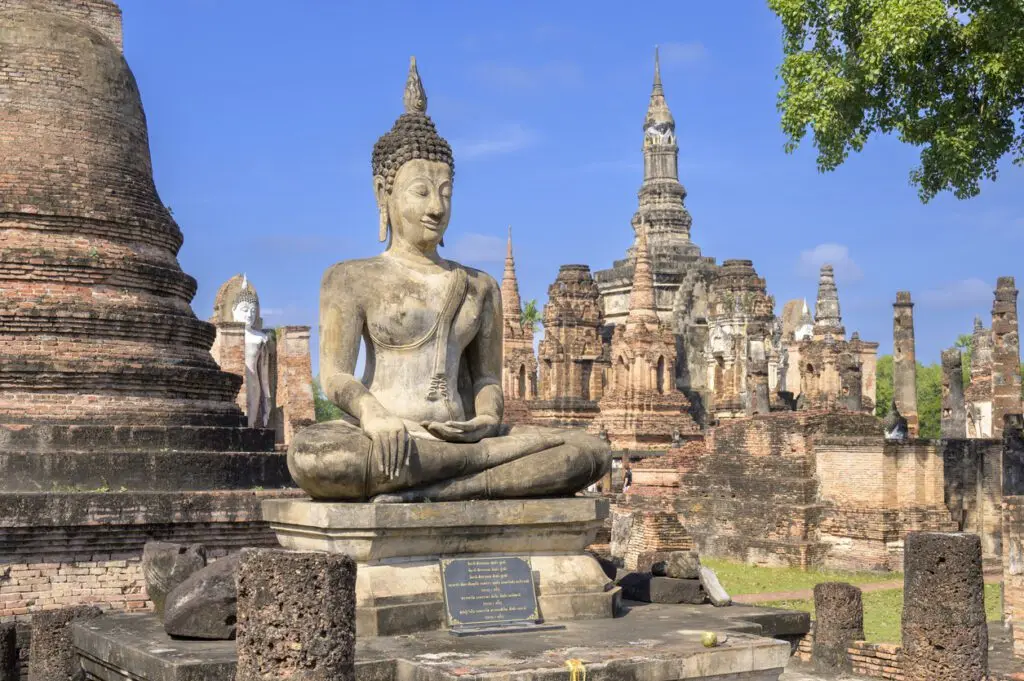
A travel guide to Sukhothai
Sukhothai, arguably the first capital of the Kingdom of Thailand, is one of the country's most important cities and boasts a rich cultural and architectural heritage. A UNESCO World Heritage Site, the province is home to numerous historical sites and temple ruins, and holds a wealth of archaeological evidence suggesting it was the first Thai kingdom to develop a writing system—the birthplace of the Thai alphabet. As its name suggests, meaning "dawn of happiness," Sukhothai is as spectacular and diverse as any of Thailand's other provinces.
Named after the kingdom that ruled the region from 1238 to 1438 and is considered the cradle of Thai civilization, present-day Sukhothai lies in the Yom River valley. It is located 300 kilometers south of Chiang Mai and 440 kilometers north of Bangkok.
Historically, the province was once renowned for its ancient porcelain production, as evidenced by significant archaeological finds in various parts of the region. While porcelain production has been revived using modern equipment and traditional skills, the traditional craft of silverware and antique gold jewelry remains a delicate art practiced by only a few artisans. The architectural style of that era continues to significantly influence the Thai art scene today.
Sukhothai lies halfway between Bangkok and Chiang Mai and is a popular stopover for travelers between the two cities. Visitors can also fly into Bangkok Airways' private airport, making Sukhothai easily accessible for years. The organic farming project on the airport grounds has become a real insider tip.
Sukhothai, a tranquil rural city where one can still enjoy the charm of a rustic lifestyle, was included in the UNESCO Creative Cities Network in 2019, along with Bangkok. It received the distinction of being named a new "Creative City of Crafts and Folk Art".
Arrival
Sukhothai is located about 440 kilometers from Bangkok, which corresponds to a travel time of approximately five and a half hours.
Bangkok Airways flies twice weekly from Bangkok to Sukhothai during the off-season (April to October); from the end of October to March, an additional flight is offered.
Website: https://www.bangkokair.com/flightdeals/view/sukhothai
Telephone: Bangkok office +662 270 6699 (24 hours)
Email: [email protected]
Telephone: New York office +1-866-BANGKOK (226-4565)
Email: [email protected]
Buses operated by Transport Co., Ltd. (locally known as "Bor Kor Sor") run from Mo Chit 2 bus station to Sukhothai bus station from early morning until 10:00 PM. The fare is 338 Baht and the journey takes approximately six hours. Tickets can be purchased by phone at +662 269 6999 or online at www.busticket.in.th (in Thai).
Other companies offer bus services between Bangkok and Sukhothai, depending on your destination within the province. Phitsanulok Yanyont Tour offers air-conditioned bus services from Bangkok to Sukhothai Historical Park. Buses depart from counters 53 and 54 at Mo Chit 2 bus terminal. Phone: +662 936 2924, +662 936 2925. Sukhothai Win Tour Limited Partnership offers bus services from Bangkok to Si Satchanalai and Sukhothai Historical Park. Phone: +6655 611 039 (head office in Sukhothai), +6687 824 5144, or the Bangkok (Mo Chit) branch at +6681 533 4402.
locomotion
The purple and pink songthaews (shared taxis) operate in the city center for four baht per ride. Between 6:00 PM and 6:00 AM, a fixed price can be negotiated. Tuk-tuks are also available. Motorcycle taxis cost between 20 and 100 baht depending on the distance.
Around the city's main market, you'll find bus stations with connections to various parts of the city. Eddy Rent A Car offers rental cars with a chauffeur service. Phone: +6681 534 1535. You can rent motorbikes from Ruengsrisiri (+6695 313 3083) opposite the Sukhothai bus station. The company also runs a guesthouse with showers if you'd like to freshen up before exploring the city.
Things to do in Sukhothai
Sukhothai Historical Park is the province's most famous attraction, encompassing the ruins of the Sukhothai Kingdom from its heyday in the 13th and 14th centuries. The city walls form a rectangle approximately 2 kilometers wide and 1.6 kilometers long, enclosing nearly 200 ruins across an area of 70 square kilometers. In 1991, the park and the associated historical cities of Si Satchanalai and Kamphaengphet were declared a UNESCO World Heritage Site.
Within the park, amidst lakes, ponds, and trees, are dozens of well-preserved and restored monuments that lend the area a natural feel. During Thailand's first independent kingdom, Thai art and architecture developed into the so-called Sukhothai style, which is heavily influenced by Khmer and Sinhalese culture. Lotus-bud chedis and statues of a striding Buddha with clothing draped around his body are two key features of the Sukhothai style.
A moat surrounds the old city, and the entire area contains the royal palace and several important temples. The ruins of dozens more temples are located at various sites outside the city walls and vary in their state of preservation. Much information about the history of the kingdom and its rulers comes from several inscribed stone stelae, including one of King Ramkhamhaeng, which was discovered during excavations in Sukhothai and its vassal cities.
Wat Mahathat is the most important and arguably the most imposing temple in the park. It was founded between 1292 and 1347 as the city's main monastery. Its name means "Temple of the Great Relic" and features a mandala motif symbolizing the universe. The main stupa, built in 1345, housed relics of the Buddha, surrounded by eight smaller stupas. The lotus bud shape of the main stupa later became a defining characteristic of Sukhothai's architecture. The monastery complex also includes 200 other smaller stupas.
A few hundred meters northwest of Wat Mahathat lies the Sa Si Temple. Situated on a small island in the middle of the lotus-strewn Tra Phang Tra Kuan pond, it is one of the most beautiful structures in the historical park. The small temple complex consists of a main chedi, a smaller chedi, a vihara, an ubosot, and a striding Buddha statue in the Sukhothai style. Thanks to its idyllic location, Wat Sa Si is a central attraction during the Loy Krathong Festival's light and sound show.
Noen Prasat, or "Palace Hill," is the remains of the royal palace of the Kingdom of Sukhothai. Built on a 200 x 200 meter square base, it was discovered in 1833 by King Rama IV, who, as a monk, was on a pilgrimage to northern Siam. Nearby were two small ponds in which archaeologists found the remains of terracotta pipes, presumably carrying water from a lake to the ponds.
Si Sawai, one of the oldest temples in the province, was built between the late 12th and early 13th centuries as a Hindu shrine to Vishnu, even before the founding of the Sukhothai kingdom. Three laterite prangs symbolize the Hindu trinity. Hindu and Khmer styles influenced the temple's architecture. Numerous Chinese porcelain pieces and statues of Hindu deities were also found in the area.
Sukhothai Historical Park is located 439.7 km north of Bangkok and can be reached by car in about five and a half hours. From Sukhothai Airport, the drive to the park takes 37 minutes (approximately 39 km). Entry costs 100 baht. A private shuttle tour (+6686 440 9210) costs 60 baht. The park is open from 6:00 am to 7:30 pm, but the ticket office closes after 6:00 pm. On Saturdays only, the park is open until 9:00 pm. The park's lighting makes it an even more captivating experience.
Visitor groups can request a tour guide who will provide detailed information about each attraction. Contact the park at +66 5569 7527 and +66 5567 9310.
One of the most frequently used attractions to promote Sukhothai and Thailand is “Phra Achana”, an 11-meter-wide and 15-meter-high seated Buddha statue inside the massive Mandapa in the middle of the complex belonging to Wat Si Chum.
Phra Achana resembles a giant Buddha, gazing from afar through a narrow opening in the ruins of the chamber. The mandapa has a square floor plan with sides measuring 32 meters and walls approximately one meter thick. A narrow staircase leads to the roof. Over time, it collapsed, leaving the Buddha to rest peacefully under the open sky. Inside the mandapa, over 50 slate tablets were discovered, depicting scenes from Buddha's life. It is considered the oldest surviving example of Thai art. A moat surrounds the entire complex. Legend has it that during times of war, the king would walk through the hidden passage to boost the morale of his soldiers. He would speak to them through a hole, making them believe the voice they heard was that of Buddha. According to another legend, a contingent of the Burmese army fled from the statue during the invasion of Sukhothai.
For some, Phra Achana is the most perfect Buddha statue in the country. The name Phra Achana means "Buddha who has no fear" and is mentioned in an inscription found at the archaeological site of Wat Si Chum. Phra Achana is also known as Phra Poot Dai, which means "talking Buddha statue."
It is a tradition among Buddhists to perform the ritual of offering food to monks from temples in their neighborhood early in the morning.
In the magnificent Sukhothai Historical Park, you can experience traditional life. Wat Trapangthong provides a breathtaking backdrop, and the large pond of the same name makes the area even more spectacular.
This unforgettable spectacle takes place daily on the wooden bridge, where locals prepare savory dishes, sweets, and flowers for the monks. Food is also available at the Tapangthong market for visitors who wish to participate in this tradition. Be there before 6:00 AM if you don't want to miss this special experience.
About 60 kilometers north of the Sukhothai Historical Park lies another city with an equally magnificent historical park.
Si Satchanalai Historical Park covers 11,150 hectares and is home to a multitude of Buddha statues and ancient buildings. Situated along the Yom River, it is remarkably well-maintained. Yet, nestled within the characteristic forest landscape between the ruins of Si Satchanalai and Chaliang, it retains a somewhat primeval feel. Si Satchanalai, meaning "City of Good People," was founded in 1250 as the second center of the Kingdom of Sukhothai. The rectangular park, along with the adjacent historical parks in Kamphaengphet and Sukhothai, has been designated a UNESCO World Heritage Site.
Si Satchanalai is believed to have been the home of another civilization as magnificent as Sukhothai. Archaeological findings suggest that this ancient city was once a center of the ceramics trade with China.
Similar to Sukhothai Historical Park, but with fewer visitors, Si Satchanalai Historical Park is located about 11 kilometers from the town center of Si Satchanalai. It is a sprawling green area with numerous ancient temples and ruins. The lush green landscape is ideal for cycling through the park.
As the Kingdom of Sukhothai grew in importance, Si Satchanalai was established as a satellite city due to its strategic location. The Thanon Phra Ruang Road connected the two cities and is considered by some Thai historians to be Thailand's first long-distance road. Si Satchanalai was founded in 1250 on the banks of the Yom River and protected by two hills that served as lookout points for enemy observation. As the city grew, stone walls and a moat were added to further enhance its defenses. The princes of Sukhothai were sent to Si Satchanalai to govern this important city within the Kingdom of Sukhothai.
Although Si Satchanalai is closely associated with the Sukhothai period of Thai history, archaeological evidence suggests that the site was already inhabited in the third and fourth centuries. At that time, the area was known as Chaliang. Visitors to the park can also see some Khmer-style ruins dating back to the pre-Sukhothai era. After the fall of the Sukhothai kingdom, Si Satchanalai remained a strategically important location, repeatedly contested by the rival kingdoms of Ayutthaya and Lanna.
Wat Phra Si Rattana Mahathat is the largest and most important historical temple in Si Satchanalai – Chaliang. As one of the oldest monasteries in the park, it is located east of the historic town of Chaliang on a small peninsula. It was founded in 1237 and thus existed before the Sukhothai era. The temple was restored during the Sukhothai and Ayutthaya periods and remains an active monastery with monks to this day.
Wat Chang Lom is another striking temple built in the Sri Lankan style. Located in the central area of the park, it is surrounded by elephants at its base. Founded in the 14th century during the Sukhothai period, it features a large, bell-shaped main chedi in the Sinhalese style. It is believed to be the temple mentioned on a stele describing how King Ramkhamhaeng unearthed Buddha relics at Si Satchanalai, reinterred them after paying homage, and then erected a chedi over them.
Wat Chedi Chet Thaeo, which translates to "Temple of the Seven Rows of Chedi," is considered the mortuary temple of the Si Satchanalai rulers. It was built between 1340 and 1350 by King Lithai of Sukhothai and is surrounded by a wall with four gates. The temple complex is impressive and contains numerous monuments in various styles, including a vihara, a main chedi, and 32 smaller chedis.
Wat Nang Phaya is the first of a series of temples radiating from the southeastern wall. It boasts the best-preserved section of wall with the ornate stucco work that once adorned all the temples of Si Satchanalai.
The drive from Sukhothai Historical Park to Si Satchanalai Historical Park along Route 1113 takes approximately 50 minutes. The park is open from 8:00 AM to 5:00 PM, and the entrance fee is 100 baht. The guided shuttle tour costs 40 baht. You can contact the park at +66 5567 9211.
The best and most recommended way to explore the historical parks of Sukhothai and Si Satchanalai is by bicycle. This allows you to comfortably visit most of the sacred sites and religious places, as well as the rural surroundings of these two parks.
Late afternoon, when the sun is lower in the sky, is the best time to visit these two parks. Si Satchanalai Park is open until 7:00 PM, so it's recommended to arrive around 3:00 PM to allow ample time for sightseeing. Sunset is the perfect moment to photograph the ancient ruins at Sukhothai Historical Park.
Visitors can rent bicycles in every park. Bicycle rental shops are located opposite the entrance to Sukhothai Historical Park. The fee is approximately 40 baht per day. To celebrate the opening of Si Satchanalai Historical Park, shops are offering bicycle rentals for 20 baht.
If you would like to explore Sukhothai in more detail, some companies offer half-day and full-day tours with a variety of programs to suit individual interests.
One of the companies that offers such tours is Cycling Sukhothai Bicycle Tour. (Tel. +6655 – 612 – 519 / +668 – 5083 – 1864, E-Mail: [email protected], Facebook and Website).
If time allows, visit the light and sound show at the Sukhothai Historical Park, which takes place during the holidays, including Loy Krathong.
Many locations in the park are used during the festival, with the Sa Si Temple being the main venue. It is situated on a small island in the middle of the lotus-strewn Tra Phang Tra Kuan pond. Every year, the festival attracts tens of thousands of visitors to the park who want to experience what is arguably the most spectacular light and sound show in the kingdom.
Besides Loy Krathong, you may have the opportunity to experience a less elaborate, but no less impressive, light and sound show. This usually takes place between July and September. For more information, contact the Tourism Authority of Thailand in Sukhothai at +6655 616 2289.
Sukhothai Airport has been one of the main reasons for the sharp increase in visitor numbers to the province since its opening in 1996.
The organic farming project at the privately owned airport adds another attraction to the already attractive travel destination.
Certain areas around Sukhothai Airport were gradually transformed into green spaces starting in the late 2000s. What began as an experiment focused on organic rice cultivation on small plots has slowly evolved into what is now known as the Sukhothai Airport Organic Farming Project.
Do you want to experience rice cultivation up close? Then you've come to the right place.
There is a wide range of activities available here. An overnight stay in Ban Thong Na is highly recommended, as it allows you to immerse yourself in the local way of life in a beautiful setting. Rice and vegetables come from the farm itself.
For inquiries, please contact us at +6655-647-196, +6687-986-4270 or by email: [email protected] or [email protected].
The outdoor activities encompass various aspects of agriculture, including using a rice mortar, selecting high-quality rice seeds, and collecting duck eggs. The one-day program starts at 9:00 AM and costs 900 baht, including meals. All food is prepared with ingredients from the farm itself. Visitors are welcome to wear traditional clothing worn by farmers in the region.
For bookings, please contact +66 55 647 290, +66 86 202 3757 or send an email to: [email protected].
Krua Sukho Restaurant is a must for food lovers, as it prepares dishes using ingredients from agricultural projects on the airport grounds. The restaurant is open daily from 8:00 AM to 5:00 PM (except Wednesdays). Highlights include pork knuckle with bread rolls, sour soup with vegetable omelet, and a kale wrap. Try the rice ice cream for dessert.
For inquiries, contact the restaurant via Facebook, +6655-647-144, +6686-398-5727 and by email: [email protected] or [email protected].
Organic farming project, Sukhothai Airport, Klong Krajong, Sawankhalok +6655 647 290.
Besides its architecture and Buddha statues, Sukhothai is also known for its most famous product and export: antique ceramics. This tradition has been passed down for generations.
Archaeological finds of ancient kilns in the districts of Muang and Si Satchanalai suggest that the villagers in these two areas produced ceramics.
Visitors can experience this traditional porcelain production, adapted to the demands of modern commerce, firsthand. In the villages surrounding Wat Trapangngoen and Wat Trapangthonglang, not far from the Sukhothai Historical Park, production can be observed on-site. There, you'll find traditional workshops producing a variety of items. In Si Satchanalai, which was the center of Sangkhalok production for at least four centuries, Baan Koh Noi (+6655 613 790) offers the perfect opportunity to paint your own porcelain and take home a souvenir.
The Sangkhalok Museum (+6655 614 333) in the Ban Lum subdistrict, Muang district, is a small but informative museum. It offers an excellent insight into ancient ceramic production through its impressive collection of around 2,000 pieces of original Thai ceramics from the region. These are displayed alongside exhibits from Myanmar, Vietnam, and China.
Food lovers will find Sukhothai heavenly, as the province offers so many delicious dishes that your mouth will water just hearing about them. Sukhothai noodle soup and Pad Thai are two examples of the culinary delights that will leave visitors feeling full and satisfied.
If you're in Sukhothai on a Friday or Saturday when the Talad Thanam Rub Saded Market is open, you can sample a variety of local specialties. This famous pedestrian market opens twice a week between 5 pm and 9 pm next to the King Ramkhamhaeng Monument in Sukhothai Historical Park. It's a paradise for anyone who loves street food, art, and crafts. The sunset at Wat Sa Si and the traditional folk dances make the experience even more unforgettable.
For those who prefer something a little more special, there are restaurants known for local dishes such as Sukhothai-style Pad Thai and rice noodles. Popular choices include Kuaitiao Sujin, Jay Hae, Sweet Rice Cafe, Kuaitiao Tapui, Baan Kru-iw, Reuan Thai Hotel, and Mai Klang Krung.
Jay Hae on Jarodvithithong Road is open daily from 7 am to 4 pm. Tel. +6655 611 901.
Tapui is located approximately 1.3 kilometers west of the Yom River on Jarodvithithong Road. It is open daily from 7:30 a.m. to 4:00 p.m. Tel.: +6684 686 8928, +6655 620 435
Poo on Jarodvithithong Road is open daily from 9:00 AM to 10:00 PM. Tel. +6693 197 4070.
In Sukhothai, there are two more specialties you absolutely must try. Both Khao Perb and Kuay Teow Bae are served at a private restaurant in Si Satchanalai. Khao Perb Yai Krieng is located in Baan Na Ton Chan, known for its award-winning homestay tourism. These legendary dishes are available daily from 8:00 am to 5:00 pm. Khao Perb are steamed rice noodles with various fillings and are only available in this village. Kuay Teow Bae resembles small, dry noodles, but all the ingredients are cooked in a steamer. Call +6656 677 3264 or +6687 036 0060 to ensure a table is available for your group.
This host family village has more to offer than just the delicious Khao Perb.
The village of Na Ton Chan (also known as Baan Na Ton Chan) is a small community in the Baan Tuek subdistrict of Si Satchanalai County. After gaining international recognition in 2012 as a winner in the prestigious "Heritage & Culture" category of the PATA Gold Awards, it has developed into a significant tourist attraction and has since received further accolades.
Today, the charming village attracts visitors with sustainable tourism and everything that has resulted from it.
Here in Na To Chan, you'll experience hospitality at its finest. Local villagers offer visitors accommodation, giving them an intimate glimpse into their daily lives. Most hosts are farmers, some of whom produce the nationally renowned clay-soaked textiles. Basket weaving and other products also testify to their industrious work. Visitors can learn the basics of basket weaving and weaving, prepare local dishes, and explore the orchards.
An overnight stay offers you a glimpse into rural life. Rise early to participate in the alms offering to the monks. Afterward, you can join the monks in their regularly held discussions about Buddhism and its philosophy of life. Enjoy the fresh, clean air of the village on foot or by bicycle. If you stay longer than one night, you can experience the spectacular sunset over the mountains. The relaxed atmosphere amidst nature and the warm hospitality will help you recharge and revitalize.
A dozen villagers have joined together to form a group of host families who offer accommodation to tourists and have established a system to ensure their high quality standards. Each individual guest must ensure that their service standard never drops, otherwise they risk losing their membership.
Na Ton Chan Village host family in the subdistrict of Baan Tuek, Si Satchanalai district +6688 495 7738.
When the Kingdom of Sukhothai was at its height, only royal goldsmiths crafted gold jewelry. Over time, this artistry was lost in the region. During the Ratanakosin era around 1930, local goldsmith families revived their heritage, combining their knowledge with techniques they had learned from Chinese artisans. They developed new skills and passed them down from generation to generation. Initially, everything was custom-made until ancient bronze weaving patterns were discovered along the Yom River. These patterns were unknown on the market at the time. The local goldsmiths studied them extensively and were later able to integrate them into their goldsmithing. This is how the Sukhothai gold jewelry we know today came to be.
There are some family businesses that continue their operations using these specific techniques. Some keep it simple, while others employ modern designs to appeal to a wider customer base.
Somsamai Gold House is one of the pioneers in the industry and remains one of the most renowned. Call +6655 679 095 or visit their website.
Somsak Gold in the Ta Chai subdistrict has also been in business for a long time. Visit their website or call +6655 679 1867.
Although small, Sukhothai's night market is vibrant and full of energy every Saturday evening. After sunset, locals gather on a street where vendors cater to the needs of foreign visitors. Here you can enjoy delicious local dishes such as Sukhothai-style noodle soup and Pad Thai. The small market also serves as a stage for performances, providing a diverse entertainment program.
For food lovers, the Sukhothai Night Market in the Muang district is an absolute must to enjoy local cuisine at fair prices in a great atmosphere. It is open from sunset until midnight.
Selected articles about Sukhothai
Thailand celebrates its newest UNESCO World Heritage Site: Discover Wat Phra Mahathat Woramahawihan in Nakhon Si Thammarat
Celebrating Thanksgiving in Thailand
Thanksgiving isn't a Thai tradition, but that doesn't mean you should miss out on it while you're here. The holiday...
Thailand travel myths: Debunking misconceptions about Thailand
Many believe they have figured out Thailand before they even arrive, but these widespread misconceptions couldn't be further from the truth...
Do you need travel information?
Discover everything you need to know before your trip – from visa requirements and entry guidelines to essential travel tips and frequently asked questions.




Community
Comments 0
Start the conversation.