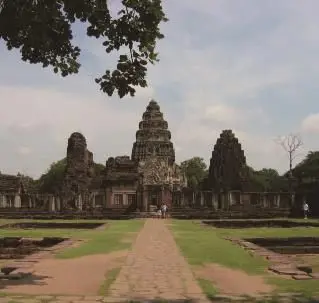
Phimai (ใส่แม็ค) is a small town in Nakhon Ratchasima province, a gateway to northeastern Thailand. It is located about 60 kilometers northeast of Nakhon Ratchasima city and about 320 kilometers from Bangkok. It is famous for Phimai Historical Park.
During the height of the Angkor Empire, what is now northeastern Thailand was an important area of life for the Khmer people. An ancient red road lined with temples connects Phimai Temple to Angkor Wat in Cambodia, the heart of the empire. Phimai Temple, along with other Khmer monuments in Thailand, predates the Angkor temple complex. Preah Vihear, Phimai, Phanom Rang, and Ma Chau are known as the four major Angkor sites in Thailand, with other smaller sites scattered throughout the region.
Best time to visit Phimai
The best time to visit Phimai is from November to April of the following year, when it is winter and spring, allowing you to avoid the hot weather. From May to October, Phimai often experiences rain, which may cause inconvenience for travelers.
Special tour
Looking for the largest banyan tree
Hidden within Phimai Historical Park is Thailand's largest banyan tree. Inside, a hidden world unfolds, complete with stone benches and shrines, its shade large enough to accommodate hundreds of people. The tree's intertwined roots and lush growth resemble a grand house, sheltering weary passersby. This banyan tree embodies the selfless and fearless spirit of trees.
Divinity can be found in Angkor Wat.
Phimai Historical Park is filled with temples and statues, and its architecture, in the Khmer style, carries a unique significance. From Wat Phanom Rum atop the extinct volcano to the exquisite bas-reliefs on the temples, everything symbolizes the communication between heaven, earth, gods, and humanity. Here, you will marvel at the connection between humanity and the universe, a connection often made through divinity.
attractions
Phimai Historical Park
Phimai Historical Park, also known as Phimai Stone Palace, is a Buddhist architectural complex in Phimai with a history of over a thousand years, built between 968 and 1001 AD. It is hailed as the "Angkor Wat of Thailand." With the assistance of the French government, Phimai Historical Park opened to the public in April 1979. In January 2009, it applied to UNESCO for inscription on the World Heritage List.
Upon arriving at this Buddhist stone palace, one can immediately recognize the colors and style of ancient Khmer architecture, proving the long and rich history between Thailand and Khmer. The city's name, "Phimai," was once the name of a tribe during the Khmer Kingdom era; the pronunciation of "Phimai" is similar to the Khmer word "Imayah."
The Stone Palace covers an area of approximately 580,000 square meters. It is a rectangular structure with sharp angles, measuring 1030 meters long and 565 meters wide, and is surrounded by a moat. The main buildings are cruciform in shape, connected by corridors. The most distinctive feature of the Stone Palace's architecture is its use of sandstone blocks as building materials. These sandstone blocks are red, yellow, and blue, giving the entire structure a natural color scheme and a rustic, natural style.
The drive from Bangkok to Phimai takes about 5 hours. You should prepare drinking water and food for the journey and plan your time accordingly.
Before arriving in Thailand, it is essential to thoroughly understand the country's unique festivals (such as Buddha's Birthday, Loy Krathong, and Songkran), its distinctive culture (religion and royal court), and important considerations for traveling to Thailand (customs and taboos, currency exchange) to ensure a smooth and enjoyable trip.




Community
Comments 0
Start the conversation.