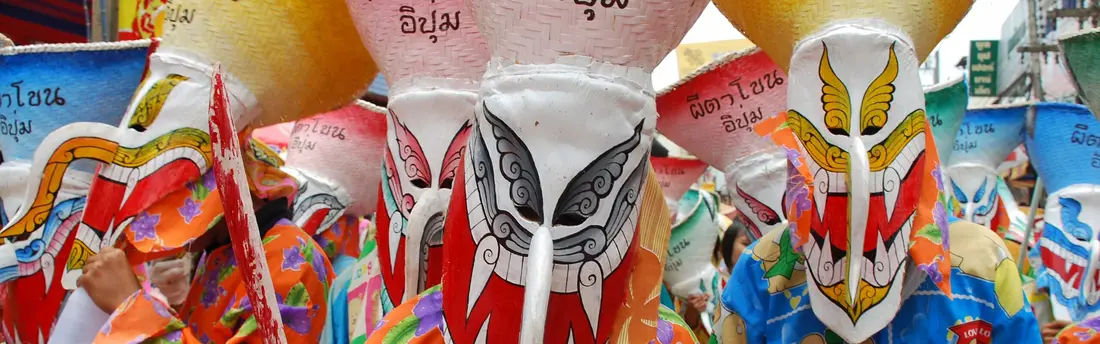
Most people know Songkran or the lanterns of Yi Peng in Thailand, but if you're looking for something off the beaten track, you should definitely put Phi Ta Khon on your list.
Often referred to as the Thai Ghost Festival, this event is a huge, colorful celebration where the whole city dons spooky masks and takes part in a massive ghost parade.
Instead of simply letting the parade pass by, we'll immerse you in the ancient stories and fascinating masks. In this guide, we'll also reveal insider tips and secrets so you can experience the festival like a local.
Brief information about the Phi Ta Khon Festival
Phi Ta Khon, originally called Phi Tam Khon, means “spirits that follow people”.
It is believed that the name derives from a famous Buddhist legend about Prince Vessantara (the penultimate incarnation of Buddha).
After performing the ultimate act of kindness during his exile, he was welcomed by the king and the people with a huge feast.
The festival was so lively and joyful that it lured the ghosts and spirits from the forest to join in the dancing. This is how the tradition of ghosts celebrating with the locals began.
This also reflects a core aspect of Thai animism: In Dan Sai, spirits are guests and not feared shadows.
When will the Phi Ta Khon Festival take place in 2026?
The Phi Ta Khon Festival 2026 will take place from June 20th to 22nd in Dan Sai.
Please note that the festival does not have a fixed annual date. Instead, the timing is determined by a local spiritual ritual.
Every year, a traditional medium called Jao Pho Kuan performs a spiritual ritual to consult the spirits and determine the dates of the festival. The official dates are only announced after this process is complete and usually fall in late June or early July.
Note: Dates are often only confirmed a few months in advance. Therefore, check TAT Loei for updates before booking non-refundable flights or hotels.
The biggest highlight of the festival is the Ghost Parade – a celebration of colors, sounds and exuberant joy.
Beneath all the dancing, teasing, and jingling bells, there's more to it than meets the eye. Every ghost, every costume, and every mask carries a meaning rooted in centuries-old beliefs.
Here are the secrets that make this Isan tradition so appealing.
Great minds versus small minds
During the festival you will see two very different types of spirits: Phi Ta Khon Yai (Great Spirits) and Phi Ta Khon Lek (Little Spirits).
Phi Ta Khon Yai (Great Spirits)
Phi Ta Khon Yai lead the parade. There are only two of them – a man and a woman.
The male figure carries a large wooden phallus, while the female figure has pronounced breasts. For the locals, these figures symbolize the wish for fertility and a good harvest.
Both consist of tall bamboo frames, inside which a person is hidden. But not everyone can create these large ghost figures.
Only certain families have this right. The artisans must perform a Wai Kru (a ceremony honoring the teacher) before beginning their work. Once they accept the commission, they must produce masks for three consecutive years.
Phi Ta Khon Lek (Little Spirits)
While the great spirits go ahead, hundreds of little spirits follow them, which is the essence of the fun at this festival.
Wearing bright masks with large teeth, ragged clothing and bells or wooden phallic props, they tease the crowd, joke around and draw people into the festivities.
Unlike the leaders, anyone can be a little ghost – even you!
The costumes and masks of Phi Ta Khon
Phi Ta Khon's costumes burst with color and sound, yet each piece is made from simple everyday objects that reflect rural life, fertility, and spiritual protection.
Let's take the tall head coverings: These are actually bamboo sticky rice steamers (Huad), which symbolize the wish for a good harvest.
The masks are hand-carved from coconut shells or soft wood from local gardens. Interestingly, their strikingly long noses are actually phallic symbols, meant to bring fertility and a bountiful harvest.
Even belts adorned with cowbells, cans, or bottle caps are not merely decorative. They summon spirits, ward off evil, and bring rain.
In the past, costumes and masks were thrown away after the festival to ward off bad luck; today, many are kept as souvenirs or sold as folk art.
Many people think Phi Ta Khon is just the ghost parade, but the festival actually spans three days and is part of the larger Bun Luang (Great Merit) Festival.
The famous Ghost Parade takes place on the second day. If you only have one day, you should make the most of it for these unforgettable experiences.
The other days also offer unique experiences, from riverside blessings to temple ceremonies. If you're looking for a quieter, more spiritual experience, consider including these two days in your itinerary.
This is what a typical day looks like:
Day 1: Welcoming the River God / Phra Uppakut Ritual
The festival begins with a sacred ritual in which Phra Uppakut, the guardian spirit of the river, is invited to protect the village in the coming days.
Around 3 a.m., the villagers, dressed in white, gather at Wat Phon Chai to march to the river, strike gongs and shout "hom~hom~" to drive away evil spirits.
They then wade into the water to retrieve three white stones that symbolize Phra Uppakut.
The stones are carried back to the temple and placed in shrines (along with offerings such as monks' robes, alms bowls, and water jugs).
Besides the river ritual, one can also observe locals giving alms at the temple or performing a soul-calling ritual (Bai Si Su Khwan) at the medium's house.
Note: The riverside ritual at 3 a.m. is deeply religious and primarily intended for locals. Participation can be difficult if you don't understand Thai and aren't prepared to get up very early.
Day 2: Phi Ta Khon Parade – the highlight of the festival
From morning until afternoon, the whole city transforms into a wild, joyful ghost carnival. Look forward to colorful masks, booming drums, and endless dancing everywhere.
Those wishing to avoid the crowds should visit Wat Phon Chai before 8:00 a.m. At that time, hundreds of young men in ghost costumes gather, transforming the tranquil temple into a surreal sea of color.
Anyone who fancies a street party can join the parade along Kaew Asa Road after 10:00 AM. Unlike stiff, formal parades, here you're not just a spectator. The ghosts approach you, tell jokes, invite you to dance, and pose for photos.
During the parade, you can also see men covered from head to toe in black mud dancing through the streets. This ritual is a prayer for fertile soil and a bountiful harvest.
The grand finale takes place around 3 p.m. with the launch of the Bun Bang Fai (bamboo rockets). Dozens of enormous, homemade rockets shoot into the sky with a deafening roar, making the entire valley tremble. This is a powerful signal to the rain gods to bring rain for a bountiful harvest.
Day 3: The formal merit activities of Bun Luang / Bun Phra Wet
Today, the focus is on listening to the holy scriptures and giving alms. Most travelers skip this part, but it forms the spiritual heart of the festival. If you are interested in the culture, you shouldn't miss it.
The monks at Wat Phon Chai begin reciting the Mahachat (the 13 chapters of the Buddha's life story) at 4 a.m. and continue well into the night. The peaceful contrast to the chaos of the previous day forms the true spiritual core of the festival, even if one doesn't understand the words.
If you would like to see it, you can visit the temple before 8:00 am and also observe the villagers giving alms.
Note: You do not have to participate in all 13 chapters of the song.
The best time to set off is after the morning rituals to avoid the traffic, or to explore nearby natural areas such as Phu Kradueng National Park.
How to participate in the Phi Ta Khon Festival – in detail
If you want more than just to watch the parade, here are some ways you can truly immerse yourself in the festival:
We strongly recommend that you visit the small museum in Phi Ta Khon first.
You will see old masks, historical photos, and how they were made. Afterward, you will begin to recognize the symbols, allusions, and underlying beliefs behind the events around you.
Anyone looking for interactive fun should visit a mask-making workshop in their area. There, you can either craft a small mask from traditional materials or paint a ready-made one. And when you're finished, you can try it on right away!
Don't miss the diverse street food of the Isan region. Try fermented sausage, grilled pork salad, sticky rice, and other local specialties from street vendors. The prices are affordable, and the flavors are authentically northeastern Thai.
Arrival in Dan Sai for the Phi Ta Khon Festival
Dan Sai is located in the heart of Isan (northeast Thailand) and roughly halfway between Bangkok and the Laotian border.
The area is remote, there is neither a train station nor direct flights, therefore the most efficient way to travel is via Loei, the nearest transport hub.
Best option: Fly to Loei
Bangkok is the only city with direct flights to Loei. This is the fastest way – a short one-hour flight followed by a 90-minute drive to Dan Sai. However, as there are only two flights per day, you should book as soon as your festival dates are confirmed.
If flights to Loei are fully booked, a flight to Phitsanulok is a good alternative. The journey to Dan Sai takes 2.5 hours.
Traveling by car: Recommended only for short distances
Buses from Bangkok or Chiang Mai are usually the last resort. The journeys often take over eight hours and can be extremely tiring for most travelers.
For shorter journeys from nearby provinces such as Sukhothai, Udon Thani, and Khon Kaen, traveling by land is the best option. All of these places are reachable within 4 hours from Dan Sai.
Public transport to Dan Sai does not follow a strict Western timetable. The minibuses usually only depart when they are full and stop at the roadside. During the festival, they are always overcrowded, and long waits or traffic jams can occur on the return journey.
For a smoother and more time-saving experience, we strongly recommend booking a private car or transfer in advance.
Where to stay in Dan Sai during the Phi Ta Khon Festival?
To fully enjoy the Phi Ta Khon Festival, it is recommended to stay in the city center of Dan Sai. Since you can easily reach the parade on foot, you will avoid spending half the day stuck in festival traffic.
However, there are a few things you should know beforehand:
Since Dan Sai is a small farming village, you shouldn't expect large hotel chains here. Your main options are small guesthouses, simple hotels, and local hostels.
The Pupiang Po Da Arte Resort is among the best hotels and is comparable to a 3-star hotel in Bangkok. For those seeking more comfort, the PhuNaCome Resort is recommended, although it is a 5- to 10-minute drive away.
During the festival, the price of a standard guest accommodation can easily rise from $15 to $30, while more upscale accommodations like PhuNaCome can climb from $80 to over $140 per night.
Although the rooms at Dan Sai are quite simply furnished, they are often fully booked as soon as the festival dates are officially announced.
So keep an eye on the festival date announcement and book immediately. Last year we couldn't get a room in the city and had to stay in Loei City. The early mornings and the exhausting festival traffic left us completely wiped out!
What happens when the hotels in Dan Sai are fully booked?
If Dan Sai is fully booked, your only alternatives are Phu Ruea (30-45 minutes away) or Loei City (1-1.5 hours away).
While these locations offer more hotels, most are still geared towards budget travelers. If you stay here, be prepared for longer travel times and higher transportation costs.
Travel tips for the Phi Ta Khon Festival
1. Warning of rainy season and heat
The festival takes place during the rainy season. Besides the sudden downpours, you also have to be prepared for the heat.
The events take place from 10:00 AM until the afternoon. Temperatures often rise above 33°C (90°F) and humidity is high. Therefore, take precautions against heatstroke.
For comfort and safety, you should bring lightweight rain gear, sunscreen, and a hat. Drink water regularly and seek shade whenever possible.
2. Language barrier
Since English is not widely spoken in this small town, it's best to download a translation app beforehand. For a smooth trip, it's advisable to hire an English-speaking local guide or driver. They will bridge the communication barrier and provide you with deeper cultural insights.
3. Cultural rules and prohibitions
This festival blends Buddhism and local spirits, so we ask you to respect the rituals.
4. Planning tips
Booking accommodation early is crucial, as rooms in Dan Sai fill up quickly. If you're staying in Phu Ruea or Loei, you should definitely arrange for a car or driver.
FAQ about the Phi Ta Khon Festival
Is a trip to Phi Ta Khon worthwhile?
Yes! Phi Ta Khon is absolutely worthwhile if you are interested in authentic culture. It is a unique tradition from northeastern Thailand that combines Buddhist rituals, ancient legends, and exuberant festivals.
You'll see colorful masks, handcrafted costumes, and a lively parade. It feels like a living theater.
But this takes place in a remote city with difficult transport links, basic accommodation, and hot weather. Anyone planning a comfortable first trip to Thailand might find this challenging.
How crowded is it?
Expect tens of thousands of Thai tourists to flock to this small town, especially for the big parade on the second day.
The streets and temples are very crowded, progress is slow, and the music is loud (bring earplugs if you are sensitive to noise).
However, you can always move into a side street if you need more space. The rest of the time, i.e., early mornings, evenings, or on days without a parade, you will feel much more relaxed.
Are foreigners allowed to participate in the parade?
Yes, absolutely! The festival is open to everyone.
You don't need any special permission – just grab a mask and a colorful patchwork costume (you can buy or rent these anywhere in the city) and join the queue.
Many locals will gladly invite you to dance, take photos, or play games together. The atmosphere is very warm and welcoming.
Is it child-friendly?
It is very family-friendly, especially during the morning parade.
Despite the "ghost" theme, the atmosphere is relaxed and cheerful, not spooky. The "ghosts" mainly tease the crowd to elicit laughter and photos, turning the whole thing into a huge, colorful street festival. Many local children can be seen in their homemade costumes.
As it gets quite crowded at midday, it is recommended to arrive early to enjoy more space and cooler temperatures.
Join the spirits: Plan your trip to Phi Ta Khon 2026 with us
Phi Ta Khon is more than a parade – it is a vibrant celebration of Thai culture, full of color, music and playful traditions.
Join the spirits in Dan Sai, enjoy the street parties and plan your trip with us to make the 2026 festival unforgettable – for a smooth and stress-free experience.
For further inspiration, you can also discover other festivals in Thailand.
Community
Comments 0
Start the conversation.