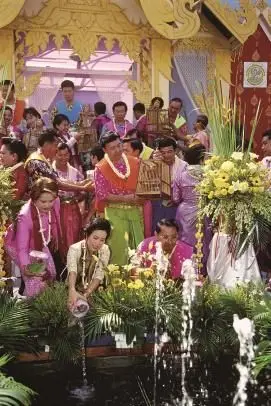
Do not wipe your nose or lick your fingers while eating. Thais place great importance on table manners, so...
Thais like red and yellow, and dislike brown. Thais traditionally use colors to represent days.
The dates are represented as follows: red for Sunday, magenta for Saturday, light blue for Friday, orange for Thursday, green for Wednesday, pink for Tuesday, and yellow for Monday.
You must not point your finger at a monk, and you must not touch a monk's body. Women, in particular, are not permitted to have any contact with monks.
Shaking hands with monks is acceptable; one should not sit next to monks in a car; even if a monk greets you, you should politely keep your distance. If a woman wishes to offer something to a monk, she should ask a man to pass it on. If you wish to offer something yourself, the monk will open a piece of his yellow robe or a handkerchief to receive it.
Every Buddha statue, regardless of size or condition, is sacred and must never be climbed upon.
Do not take photos or do anything disrespectful to Buddha statues. Never give cash to monks begging for alms, as this violates monastic vows.
Inside the mosque, men must wear hats; women should wear trousers or long skirts and cover their hair with a scarf.
Showing respect to the royal family. Thais have great respect for their King, Queen, and royal family.
Because of the royal family, one must be extremely cautious when discussing the monarchy in front of Thai people, as Thai law includes penalties for disrespect towards the royal family. Therefore, tourists should demonstrate appropriate etiquette; for example, when royal family members are present in public, it is best to observe the actions of others and follow suit.
Clothing and attire. Thai temples are considered sacred places by the Thai people. Please dress appropriately when entering a Buddhist temple.
When entering a temple, visitors must dress appropriately and modestly; short skirts, shorts, or revealing clothing are not permitted. When entering a Buddhist temple, mosque, or private residence, visitors must remove their shoes and be careful not to step on the threshold.
Thai women are generally conservative, so please do not touch them without their consent.
Thai people often add the suffix "Khun" before a person's name, regardless of whether it's a given name or not.
Suitable for both men and women, it signifies "Mr.", "Miss" or "Madam".
The head is sacred. Do not touch another person's head or disturb their hair.
In Thailand, the head is considered an important part of the body where spirits reside. If you accidentally touch someone's head, you should apologize sincerely immediately. Thais also consider it taboo for strangers to touch children (especially young children).
The head of a child is considered very important; only the King, monks, and their parents are allowed to touch a child's head. Even barbers cannot touch other people's heads without permission and must say "excuse me" before cutting their hair. Thais do not sleep with their heads facing west, as the setting sun in the west symbolizes death. When building houses, Thais traditionally face south or north, never west. Furthermore, having a beard is considered impolite.
The left hand is considered unclean. Thais believe the right hand is clean while the left is unclean; the left hand is only for holding one thing.
Therefore, important things should be held with the right hand. On more important occasions, they should be presented with both hands.
The soles of the feet are considered unclean, just like the left hand. When sitting down, avoid...
Do not put your feet on the table, and you will be severely reprimanded for tapping or pointing at people with your toes. Never point your feet at the Buddha. In addition, you should not kick doors or point at things with your feet, and you should not cross your legs or point the soles of your feet at others when sitting.
Other taboos: ① Thais do not use red pens to sign their names. ② In some rural areas, it is taboo to praise children.
The child is beautiful. ③ Do not pick up the Floating Lanterns. Thais hold the Loy Krathong Festival every year during the full moon of the 12th month of the Thai calendar, which is Thailand's most lively festival. When viewing the Floating Lanterns, be careful not to pick them up, no matter how exquisite or beautiful they are; otherwise, you will be severely punished.
Community
Comments 0
Start the conversation.