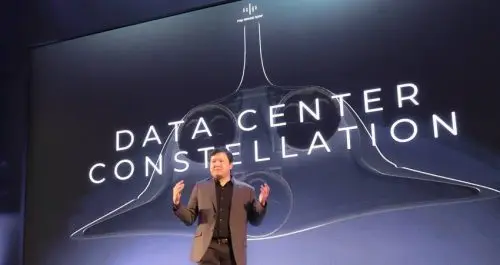
Bangkok, Thailand, October 20, 2020 / TRAVELINDEX / mu Space has unveiled its plan for the development of space technologies following the press conference on the signing of a Memorandum of Understanding between TOT and muSpace to promote research and development in the space industry.
This is the fourth launch of payload and experimental equipment into space with Blue Origin as part of the New Shepard mission (NS-13) aboard the New Shepard rocket. mu Space, led by James Varayuth Yenbamroong, an entrepreneur and engineer in the aerospace and satellite industry, unveiled a further plan for the development of space technologies and confirmed the project to create a High Throughput Satellite (HTS).
• Currently possibly for sale: The only global space domain madeinspace.com – inquire here…
More than 40% of the materials used inside the satellites are manufactured by mu Space and local producers using Thai technology. The launch of this satellite is planned for 2024. Another ambitious goal of mu Space is to become Thailand's first foreign satellite operator once an Open Skies policy comes into effect.
The arrival of the Earth satellite in low Earth orbit (LEO) will be of great benefit and importance for future communication systems. It is also considered a crucial step in modernizing Thailand's communication technology to remain competitive with other countries.
To support new technologies such as 5G, cloud storage, online transactions, and enhanced business security, mu Space offers a new alternative for Thais and enables the development of forward-looking business models. mu Space comprehensively meets its customers' needs while contributing to more efficient and widespread signal transmission.
The highlight of this initiative is the plan to establish a spacecraft or the first small spacecraft in Thailand. This plan is based on several important objectives that are to be achieved.
1) The goal is to build a data center outside the Earth's atmosphere. This eliminates the biggest problems in setting up data center infrastructure, such as the necessary temperature stability and the low temperatures required for system operation. Up to 40% of the total power consumption (investigation of subsystem power consumption) will thus be shifted to an ambient temperature of -270 °C, thereby eliminating temperature-related problems.
2) This means using pure energy without relying on Earth's energy resources. The spacecraft will orbit in space and continuously receive solar energy from its underside. It can therefore function autonomously without dependence on Earth's energy resources. This leads to the next consequence.
3) Security is ensured by the interconnected spacecraft hovering in the sky. This protects Earth from natural disasters and accidents such as fires and floods. The networking of large groups covering the entire world guarantees seamless and global connectivity.
As part of its development work, mu Space has begun testing suitable construction materials. In August, a strength test was conducted, simulating a special projectile traveling at a speed equivalent to that of space debris. Traveling at over 1,100 m/s, the projectile is expected to achieve protection class 3 for bullets by 2020. Currently, mu Space is preparing to build a medium-sized factory in order to begin spacecraft production in 2021.


Community
Comments 0
Start the conversation.