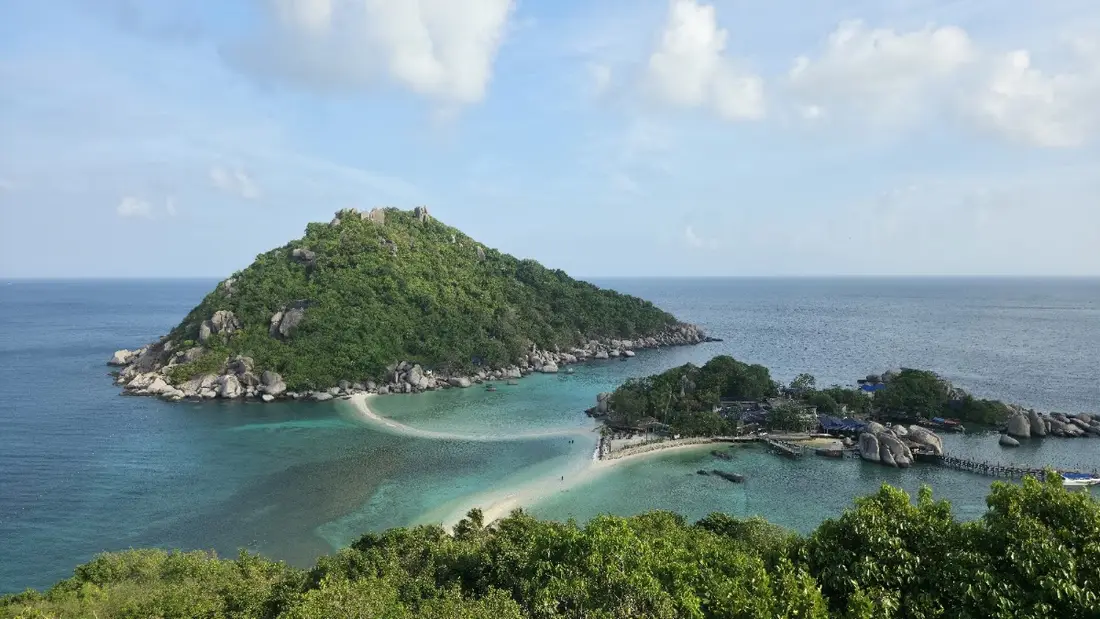
Koh Tao is a small, steeply sloping island in the Gulf of Thailand. With an area of approximately 21 km², characterized by granite boulders and small bays, it lies one to two hours by boat from Koh Samui and Koh Phangan. It is one of the most popular diving destinations in the world, and an open water course here costs around 11,000–12,500 baht. There are dozens of dive schools on the west coast. But even without diving, the island can be wonderfully enjoyed. The snorkeling spots off the beaches are the best in the Gulf, the three islands of Koh Nang Yuan and their sandbar are just a short boat ride away, and the viewpoints reward the strenuous climb.
Spend your holiday on Sairee with its bars and sunsets, on Chalok Baan Kao if you're looking for peace and quiet, or in a bay on the east coast like Tanote to escape the crowds. Plan for four nights, longer for a sailing, and travel between February and September, as the monsoon season from October to December brings rain and rough seas.
Accommodation in Koh Tao
This route ends in Koh Tao. Search for hotels in Koh Tao for your travel dates or narrow your search to the region you wish to visit. Filter for hotels with free cancellation if you'd like to book a room and decide later.
Open Booking.com with your travel dates · also on Expedia · Trip.com
My picks in every price category on Koh Tao
Key facts
An open water course costs approximately 11,000–12,500 baht.
Three to four days, with accommodation offered free or at a reduced rate at many dive schools. Introductory dives cost approximately 800–1200 baht each, cheaper as part of a package.
Koh Nang Yuan charges 250 Baht for entry; plastic bottles are not allowed.
Children pay 120 baht. A water taxi ride from Sairee costs about 250–300 baht per person for a round trip and takes 15 minutes each way.
There is no airport, only boats.
The speedboat from Koh Samui takes 1.5 to 2 hours and costs 700 baht. From Bangkok, you can reach the destination by taking the Lomprayah night bus and catamaran at 8:45 am for 1,250 baht.
The roads are steep, so think carefully about whether you want to use a scooter.
Scooters cost around 200–300 baht per day, but the concrete hills and unpaved roads to the bays on the east coast pose a challenge for many riders. Taxis and water taxis cover all routes.
Bring cash to cover the small fees.
There is an entrance fee of 50–100 baht for viewpoints and some beaches. ATMs in 7-Eleven stores and banks in Mae Haad charge 250–350 baht per withdrawal with foreign cards.
The rainy season lasts from October to December.
In November, the Koh Samui weather station receives an average of 445 mm of rain, which can lead to the cancellation of boat trips. February is the driest month with 64 mm.
Would you like your Thailand trip planned and booked for you?
Tell me your travel dates, your budget, and who will be traveling with you. I will then suggest a route, recommend hotels, and arrange transfers between destinations. Once you are satisfied, you can book.
Is Koh Tao worth a visit?
Yes, especially if you want to learn to dive or snorkel. The waters around Koh Tao are warm, usually calm from February to September, and teeming with life near the shore. You can spot turtles and blacktip reef sharks in the bays. Learning here costs only a fraction of what it costs in most other parts of the world, and the whole island is geared towards it – from the dive boats that leave at dawn to the sundowner beers at the sairee afterwards.
It's not an island with long beaches. Sairee is the only large sandy beach; the other beaches are small coves accessible via steep roads or by boat. The island's west coast is densely built up and busy, and those who value hotel pools and a selection of long beaches are better off on Koh Samui.
Koh Tao or Koh Samui? Koh Samui offers comfort, is family-friendly, and has large hotels. Koh Tao, on the other hand, is excellent for diving and snorkeling and attracts a younger, more sociable crowd. Many visitors take trips to both islands, as the boat ride between them takes less than two hours.
Diving on Koh Tao
An Open Water course, the first full diving certification, lasts three to four days and costs approximately 11,000–12,500 baht, depending on the dive center and whether it's PADI or SSI. Ban's Diving Resort charges 11,000 baht for its PADI course, including discounted rooms, while Crystal Dive charges 12,500 baht for the SSI course, including four nights' accommodation. An Advanced course costs about 10,000–12,000 baht more. Price differences between schools are minimal, so choose based on class size, reviews, and your personal preference regarding the instructors.
If you're unsure whether diving is for you, you can try a Discover Scuba Diving experience – a one-day dive with an instructor to a maximum depth of 12 meters, without certification. Certified divers pay approximately 800–1,200 baht per dive; booking a dive package is cheaper.
The island offers over 25 dive sites. Practice dive sites like Japanese Gardens and Twins are shallow and sheltered. The deeper rock pinnacles Chumphon Pinnacle and Sail Rock, both reaching depths of around 45 meters, are the top dive sites and where whale sharks are most commonly seen. There is no fixed season for them, and most sightings are reported between February and September.
The sights that make the trip worthwhile
These five places are ones I would definitely include in my itinerary after diving on my first visit. The complete ranking, including all entrance fees and opening times, a comparison of snorkeling bays and viewpoints, tips for the rainy season, and recommendations on what you can safely skip, can be found in "Activities on Koh Tao".
A snorkeling trip around Koh Tao
If you're only taking an organized excursion, opt for a snorkeling tour around the island. The best snorkeling spots around Koh Tao are mostly located in bays that are only accessible via long, steep access roads or are even inaccessible by car. A boat will take you to five of these bays in one day, including lunch on board, snorkeling masks, fins, and the Koh Nang Yuan fee.
How many days does one need on Koh Tao?
Four nights is ideal for most non-divers. This gives you one day for Koh Nang Yuan and Sairee, one day for a snorkeling trip around the island, one day for the south coast with Shark Bay, Freedom Beach and the John-Suwan viewpoint, and one free day in case the weather isn't good or you simply want to relax.
If you're taking the Open Water course, plan for four days for the course itself, followed by one or two days for diving or resting before your flight. Many course participants stay for several weeks.
Accommodation on Koh Tao
Sairee is the standard resort with a beach, dive schools, and nightlife. Mae Haad is good for early morning boat trips, Chalok Baan Kao offers quiet spots with restaurants nearby, and the bays on the east coast are perfect for escaping the crowds—provided the steep road doesn't deter you. You can find all these areas, along with hotel deals and taxi fares, in my Koh Tao accommodation guide.
The best-rated hotels in Koh Tao
Here is my ranking of the 10 best hotels in Koh Tao. Each button opens the hotel on Booking.com, where you have already entered your travel dates.
Arrival in Koh Tao
From Bangkok, the easiest way to get there is to combine Lomprayah's combined ticket, a night bus from Khao San Road, and the catamaran from Chumphon (arriving at 8:45 a.m. for 1,250 baht) or the slow ferry for 850 baht. Taking the night train to Chumphon plus the subsequent boat crossing costs around 1,630 baht. Alternatively, you can fly to Chumphon at 7:25 a.m. and reach Koh Tao around 3:00 p.m. My Bangkok–Koh Tao travel guide covers all these options.
From Koh Samui, speedboats take 1.5 to 2 hours and cost 700 baht, while slower ferries take up to three hours and cost 450–550 baht. From Koh Phangan, the crossing takes about an hour. All boats dock at Mae Haad Pier on the west coast.
Bookable departures · updated daily
Bangkok → Koh Tao: Departure times you can book now
All flights currently bookable via 12Go on this route, sorted by booking class. The prices shown are distributed across the different booking classes; the exact price for a seat and a specific date can be found on the booking page.
bus
Ferry & Speedboat
12Go timetables and fares are updated daily. Services that operate only locally—regular trains, weekend trips, and ferry terminal tickets—are not listed; these can be found in the table above. Sponsored link: We may receive a commission if you book, at no extra cost to you.
Book bus and boat from Bangkok to Koh Tao
12Go sells the Lomprayah and Boonsiri combinations as well as the train and boat packages all in one place, including seats for your date.
Sponsored link – We may receive a small commission if you book, at no extra cost to you. Learn more.
Getting around on Koh Tao
The west coast between Mae Haad and Sairee is easily explored on foot. For longer distances, shared taxis (pick-up trucks) wait at the pier and in Sairee. The short ride from Mae Haad to Sairee costs about 100 baht per person if you share a taxi. It's more expensive to reach the bays on the east coast. Water taxis are often the more comfortable option for the more distant bays and cost about 150–200 baht from Mae Haad to Tanote.
Scooters cost around 200–300 baht per day, but the roads on Koh Tao are very steep and made of concrete, with sand and gravel on the bends, and the roads down to the bays on the east coast are even bumpier. If you don't have much driving experience, it's best to take a taxi. Tap water is not safe to drink, so buy bottled water or refill your own bottles.
When should you go?
Koh Tao is located on the Gulf of Mexico, so its seasons differ from those in Phuket and Krabi. The best time to visit is from February to September, when the sea is calm and the water is particularly clear for diving. February is the driest month. Koh Tao doesn't have its own weather station, but the two nearest stations – Koh Samui (about 70 km south) and Chumphon (about 85 km west on the mainland) – report consistent results. These stations receive approximately 64 mm and 52 mm of rain, respectively, in February. July and August are peak season due to the European summer holidays. During this time, Koh Samui receives about 100–120 mm of rain per month, which is roughly a quarter of the rainfall in November.
From October to December, it's monsoon season here. November is the wettest month at both nearby dive centers, with approximately 445 mm of rainfall in Samui and 259 mm in Chumphon. During this time, rough seas or boat breakdowns are possible, and visibility for diving is limited. While dive courses do take place, it's the worst time to plan a diving trip.
Plan the rest of your trip.
Frequently Asked Questions
Frequently asked questions about the Koh Tao travel guide.
Yes, it's ideal for diving, snorkeling, and a relaxed island lifestyle. It's one of the most popular places worldwide to learn to dive, the snorkeling spots right off the beaches are the best in the Gulf of Mexico, and Koh Nang Yuan is just a short boat ride away. You won't find long beaches or large resorts here.
Approximately 11,000–12,500 baht for three to four days, PADI or SSI. Many dive centers offer accommodation included or at a discount. Ban's Diving Resort charges 11,000 baht for PADI and Crystal Dive 12,500 baht for SSI, both including four nights' accommodation.
Four nights are recommended if you're not diving, for Koh Nang Yuan, a snorkeling trip, the south coast, and an extra day. For an open water course, you should plan for another four days.
Rooms and meals cost about the same as on the other Gulf islands, and diving is inexpensive by international standards. However, the small additional costs add up: 50–100 baht entrance fees at viewpoints and some beaches, 250 baht for Koh Nang Yuan, and 250–350 baht per cash withdrawal from an ATM using a foreign card.
Koh Samui is ideal for families, offering comfortable accommodations and large hotels. Koh Tao, on the other hand, is excellent for diving and snorkeling and is popular with a younger crowd. The boat trip between the two islands takes 1.5 to 2 hours, making it easy to combine both.
250 baht for adults and 120 baht for children, plus approximately 250–300 baht per person for the round trip by water taxi from Sairee or Mae Haad. Plastic bottles are not allowed on the island.
Sairee is ideal for the beach, diving schools, and nightlife. Chalok Baan Kao offers quieter spots, Mae Haad has an early ferry connection, and a bay on the east coast like Tanote provides seclusion.
The Gulf monsoon season lasts from October to December. November is the wettest month; ferry services can be rough or cancelled, and visibility for diving is limited. The best time to travel is from February to September.
Compare prices on the major booking portals and filter for rooms with free cancellation if you want to book now and decide later.
Compare prices on Booking.com
Compare prices on Trip.com
We may receive a commission for bookings made through these links – this will not incur any additional costs for you. Learn more.
You might also like this
Bangkok travel guide
A city with three zones and a river – once you understand the structure, everything else falls into place.
Chiang Mai City Guide
A walled square, a mountain, and the best value for money for good living in Thailand – if you know the calendar.
Things to do in Bangkok
Ten experiences worth traveling to – sorted by rank, price and time, so you can experience each one at the best time.
Things to do in Chiang Mai
Twenty-five things worth a trip to the north, ranked by rank, price and time of year to visit, centered around the mountain, the markets and the smoke-free months.
Best time to travel to Thailand
The best time to travel is from November to February; the rest of the year is best on the east coast.
I lived in Bangkok for four years and traveled throughout the country from there. The guidebooks reflect my personal opinion and are written as I would explain things to a friend planning a trip.
Ready to create your travel itinerary?
Use our free trip planner to save places, organize days, and share your trip.

Community
Comments 0
Start the conversation.