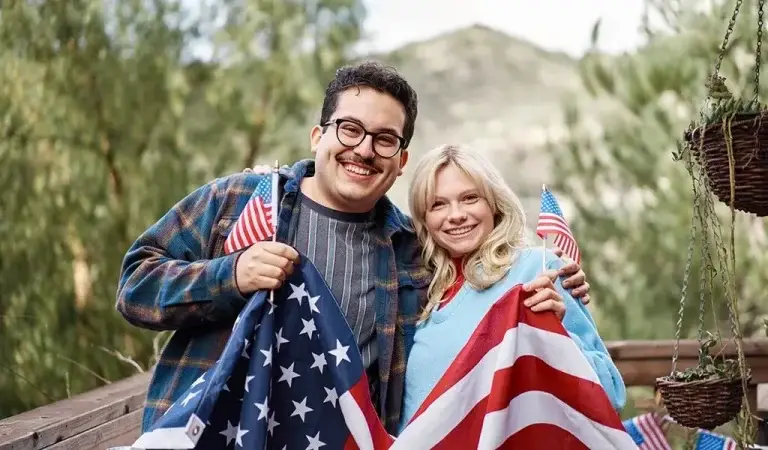
Bringing your partner to the USA is an exciting but often complex process. In this article, we, as a K-1 visa sponsor, will guide you through the practical aspects of the visa application and provide helpful information that can simplify the process for you and your fiancé(e).
Understanding the K1 visa
The K-1 visa, also known as the fiancé(e) visa, is for foreign fiancés of U.S. citizens. It allows the fiancé(e) to enter the United States and marry their U.S. spouse within 90 days of arrival. After the marriage, the foreign spouse can apply for permanent residency.
Participation requirements
Before beginning the application process, it is crucial to ensure that both parties meet the requirements. The U.S. citizen must be a U.S. citizen and cannot simply hold permanent residency. Both parties must be of marriageable age. Furthermore, they should have met in person within the two years prior to application, unless a face-to-face meeting would violate cultural or social norms or constitute an undue hardship.
Initiation of the process
The application process for the K-1 visa begins with the U.S. citizen, as the sponsor, submitting Form I-129F, Application for Entry of Foreign Fiancé(e), to U.S. Citizenship and Immigration Services (USCIS). This form serves as the official application to classify the foreign fiancé(e) as eligible to enter the United States for the purpose of marriage.
Approval and consular processing
Once the application is approved, it is forwarded to the U.S. embassy or consulate in the foreign fiancé(e)'s home country. The foreign fiancé(e) must then apply for a K-1 visa, undergo a medical examination, and complete a visa interview. The U.S. embassy or consulate issues the visa if all requirements are met.
Financial responsibility
A crucial aspect of the K-1 visa sponsorship process is demonstrating financial capacity. The U.S. sponsor must prove they have the means to financially support their fiancé(e). This often involves submitting financial documents such as tax returns, employment records, and a letter of intent to marry within 90 days of entering the U.S.
Conditional Green Card and status adjustment
After marriage in the U.S., the foreign spouse can apply for a conditional green card. This grants them conditional permanent residency for two years. To remove the conditions, the couple must jointly file Form I-751 (Request to Remove Conditions of Residence) within 90 days before the conditional green card expires.
Common challenges and how to overcome them
Applying for a K-1 visa can sometimes be difficult. Delays can arise from incomplete documentation, changed personal circumstances, or the need for additional evidence. To minimize these difficulties, it is important to remain well-organized, maintain contact with immigration authorities, and seek legal advice if necessary.
Possible rejection of a K1 visa application
Being denied a K-1 visa application can be discouraging, but understanding the possible reasons for rejection can help applicants address these issues and increase their chances of success. Here are some common reasons for K-1 visa application rejection:
Inadmissibility or non-compliance with the requirements
The US citizen or foreign fiancé(e) does not meet the eligibility criteria, such as legal eligibility to marry, meeting in person within the prescribed time period, or US citizenship.
Incomplete or faulty documentation
Failure to submit all required documents or providing incomplete or incorrect information may result in visa denial. It is therefore essential to carefully follow the instructions of U.S. Citizenship and Immigration Services (USCIS) and the U.S. Embassy or Consulate.
Criminal record
Certain criminal convictions, particularly those related to violent crimes or drug trafficking, can lead to visa refusal. Applicants should be aware of the impact of their criminal record on the visa application process.
Fraud or misrepresentation
Providing false information, submitting forged documents, or attempting to deceive immigration authorities can lead to visa refusal. Honesty and transparency throughout the entire application process are therefore essential.
Insufficient financial support
The US sponsor must prove that they can financially support their fiancé(e). If the sponsor's income or financial situation is insufficient, this can lead to visa denial. Proof of financial stability is therefore essential.
Health problems
Certain medical conditions can lead to visa refusal if they are deemed a threat to public health or safety. Applicants must undergo a medical examination as part of the visa application process.
Security concerns
If it turns out that the U.S. citizen or foreign fiancé(e) has links to criminal or terrorist activities, this can lead to visa denial. Background checks are conducted as part of the visa application process.
Previous violations of immigration law
If either the US sponsor or the foreign fiancé(e) has violated immigration regulations or overstayed their visa in the past, this may negatively affect the K1 visa application.
Failure to appear for the visa interview
Both the U.S. citizen and their foreign fiancé(e) are generally required to attend a visa interview. Failure to appear for the visa interview without a valid reason can lead to the visa application being denied.
Failure to overcome a previous visa refusal
If the applicant has previously been refused a visa and does not address the reasons for the refusal, this may lead to a further refusal.
Diploma
Bringing a loved one to the U.S. via the K-1 visa process requires careful adherence to legal regulations. By understanding the requirements, initiating the process, demonstrating your financial resources, and addressing potential difficulties, you can ease the path for those embarking on the journey of love across borders.
Contact Siam Legal
[column size='1/2']
LIVE SUPPORT
CALL
CHAT
Chat with our employee
From Thailand: Monday – Friday 4:00 – 18:00 (Bangkok time)
Community
Comments 0
Start the conversation.