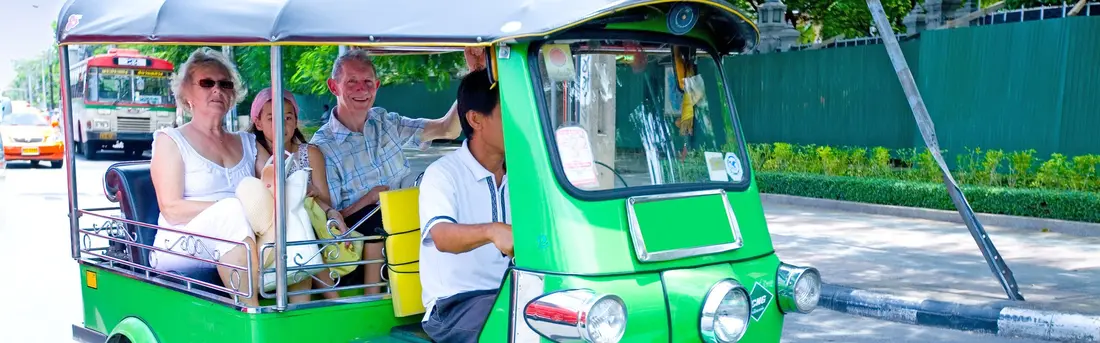
Short answer: Yes – Thailand will remain a very safe country for international travelers in 2026.
Millions of people visit Bangkok every year, and most trips go smoothly. Bangkok was once again named the world's most visited city in 2025 (source: Euromonitor 2025), and Chiang Mai regularly ranks among the safest cities in Southeast Asia (Numbeo Safety Index).
Thailand is predominantly Buddhist, and this is reflected in everyday life. The people are polite, peaceful, and genuinely friendly. You notice this in small things – the wai greeting, smiles, and the uncomplicated way people interact. Tourism plays a vital role in the economy, so the safety of travelers is a top priority.
Of course, that doesn't mean things never go wrong. You should pay particular attention to minor fraud attempts, traffic, and a bit of common sense.
During my travels in December 2025 and February 2026, including the flower festival in Chiang Mai, I felt just as safe as before. I strolled through night markets, walked back to the hotel after midnight, and treated myself to late-night massages—all without a care in the world.
Even in places like Chiang Rai, the Golden Triangle and Kanchanaburi, daily life and sightseeing proceeded as usual, without any significant security problems.
Below I will explain the few risks you might actually encounter and how you can deal with them so that you can travel without worry.
What you should actually pay attention to
1. Fraud (The most common problem)
This is probably the most common problem travelers encounter, especially in popular tourist areas. While these scams can be annoying, they are rarely dangerous.
A common situation is the following:
Someone approaches you near a popular tourist attraction and says it's "closed today," then offers to take you to another location at a discounted price. This might sound tempting, but it's almost always a trap.
This is most commonly heard of in the following area:
A simple rule to remember: In most cases, a simple "No, thank you" and walking away is sufficient.
Some other scams you should be aware of:
1) Scams involving tuk-tuk “cheap tours”
They can often be found in the area around the Grand Palace, on Khao San Road, and sometimes near important temples in Bangkok.
A driver might offer a "city tour for 20 baht" or a "very cheap temple tour." The catch is that he doesn't take you directly to the sights, but stops at jewelry stores, tailors, or souvenir shops where he collects commissions. The prices are usually higher than usual, and you may be pressured to buy something.
2) Fraudulent schemes involving damage to jet skis or motorcycles
This occurs most frequently in Phuket, Pattaya and Koh Samui, especially on busy beaches.
You rent a jet ski or a motorcycle, return it, and the owner claims you caused damage even though you didn't, and demands compensation.
2. Traffic and transport risks (More important than you think)
This is something that many travelers don't realize at first.
Road safety is not comparable to that in Western countries, and motorcycle accidents are among the most common problems tourists face.
If this is your first time in Thailand:
If you prefer something simpler and more convenient, using a private car with a driver is an excellent option.
3. Petty theft (Not a big problem, but it happens)
This doesn't happen to most travelers, but it can happen in crowded places like night markets or busy streets.
Just keep an eye on your belongings, and everything will probably be fine.
Is Thailand safe at night?
Yes – and in most places there is a very relaxed atmosphere in the evenings.
Night markets, street food stalls, and lively neighborhoods are bustling with life until late in the evening. You'll see locals and tourists alike, all enjoying the atmosphere.
In my experience, nights in Thailand are more peaceful than tense. During my trip, for example, after celebrating New Year's Eve in Chiang Mai on December 31, 2025, I walked back to my hotel alone around 1 a.m. The streets were quiet, but I felt completely at ease.
On most of my trips, I treated myself to massages in the evenings and spent time trying street food and strolling through the stalls. Even when the streets weren't crowded, I felt safe there.
Is Thailand safe for bars and nightlife?
Yes – the nightlife in Thailand is lively and generally very safe.
Areas like Khao San Road, Soi Cowboy, and Bangla Road are lively, sociable, and full of travelers. Most evenings go smoothly.
As everywhere else: Keep an eye on your drink, your belongings, and your way home.
Recommended reading: Looking for tips for a smooth trip to Thailand? Then read "How do I plan a trip to Thailand?".
Is Thailand safe for women traveling alone?
Yes – and it is one of the easiest places in Southeast Asia to travel to alone.
In cities like Bangkok and Chiang Mai, going out alone is perfectly normal. Treating yourself to a massage late at night or strolling through a night market by yourself is simply part of everyday life.
People dress casually – tank tops, shorts, dresses – and this rarely leads to unwanted attention.
Even at night, areas like Sukhumvit or the old city of Chiang Mai are lively and well-lit. Sitting alone in a café or bar doesn't feel unusual at all.
If you ever feel uncomfortable, just go into a 7-Eleven or a pharmacy – they're everywhere and you can quickly hide inside.
A few simple things that help:
If you want complete flexibility without stress, a private driver and local support can make things even easier – especially on your first trip.
Is Thailand safe for families?
Yes – Thailand is one of the easiest travel destinations in Southeast Asia for families with children.
It's generally safe, easy to get around, and very family-friendly. You see lots of children in hotels, shopping centers, night markets, and at tourist attractions, so you don't feel out of place at all.
When planning a family trip, parents typically ask the following questions:
Q: Is it okay for children to eat street food? A: Yes – and it's part of the experience.
The key is simply to choose the right places. Bustling night markets like Jodd Fairs in Bangkok or the Saturday pedestrian zone in Chiang Mai are ideal, as the food is freshly prepared and sells quickly.
For children, you should stick to freshly prepared food, peeled fruit and bottled water.
Q: What if my child gets sick? A: They are in good hands.
Thailand boasts excellent private clinics, particularly in cities like Bangkok, Chiang Mai, and Phuket. Facilities such as Bumrungrad International Hospital are modern, efficient, and offer 24/7 English-speaking doctors.
Q: Do I need to worry about car seats? A: That's something you should plan for in advance.
Regular taxis generally do not offer child seats. If you are traveling with young children, it is recommended to book a private transfer where child seats can be requested.
Q: Where should we stay as a family? A: Choose areas away from the nightlife. The riverfront district in Bangkok, the old city of Chiang Mai, or the resort areas in Phuket are good options.
When planning your trip, you can find inspiration on our page “How to plan the perfect family trip to Thailand”.
A few more questions that travelers often ask
Q: Is it safe to travel to Thailand during festivals or holidays? A: Yes – and honestly, it's one of the best times to travel.
Festivals like Songkran or Yi Peng can get very crowded, but the atmosphere is joyful and well-organized. You see families, tourists, and locals all celebrating together.
Just keep an eye on your belongings in busy areas, and everything will be fine.
Q: Are beaches and water sports safe? A: Yes, in most places they are very safe.
The popular beaches in Phuket, Krabi, and the islands are well-equipped for tourists. However, strong currents should be a concern on some days.
If you follow the flags, listen to the lifeguards, and book activities through reputable providers, you will have no problems.
Q: Do I need to worry about natural hazards? A: Not really – you just need to pay attention to the seasons.
The rainy season (June to October) can bring heavy rainfall and occasional flooding, especially in coastal areas. This usually won't affect your entire trip, but it might disrupt your plans for a day or two.
A quick weather check before starting activities is usually sufficient.
Q: Is it okay to visit Chiang Mai during the slash-and-burn season (February–April)? A: That depends on your sense of security.
Air quality can be noticeably worse during this time. Many travelers still visit and enjoy the city, but outdoor activities may be less pleasant on some days.
If you are sensitive to air quality, it is better to limit time spent outdoors, wear a mask if necessary, or plan more indoor activities.
Q: Should I be worried about pickpocketing? A: Not a big worry, but it can happen in crowded places.
Think of night markets, busy streets, or public transportation. It's usually opportunistic and not targeted.
Simply keep your valuables close to you, and you will probably have no problems.
Q: Are taxis and public transport safe? A: Yes, you just have to use the right ones.
In cities like Bangkok, Grab is the easiest option. Taxis with a meter are also fine – just make sure the driver is using the meter.
Do not accept unsolicited offers from drivers who approach you on the street.
Q: Is it safe to use credit cards in Thailand? A: Yes, absolutely.
Card payments are widely accepted in cities, shopping centers, and hotels. For added security, you should use ATMs at banks and avoid entering your card details on public Wi-Fi networks.
Most travelers use cards without any problems.
Q: Can I drink tap water in Thailand? A: It's better not to.
It's best to use bottled or filtered water, which is inexpensive and readily available everywhere. Hotels and restaurants always offer safe drinking water alternatives.
It's a simple habit that will help you avoid stomach problems.
Q: Will border tensions with Cambodia affect travel in 2026? A: No – you won't notice.
Sometimes you see news reports about border regions, but these are far removed from the places travelers visit.
Places like Bangkok, Chiang Mai and Phuket are far removed from these areas, and even the crossings to Angkor Wat are operating normally.




Community
Comments 0
Start the conversation.