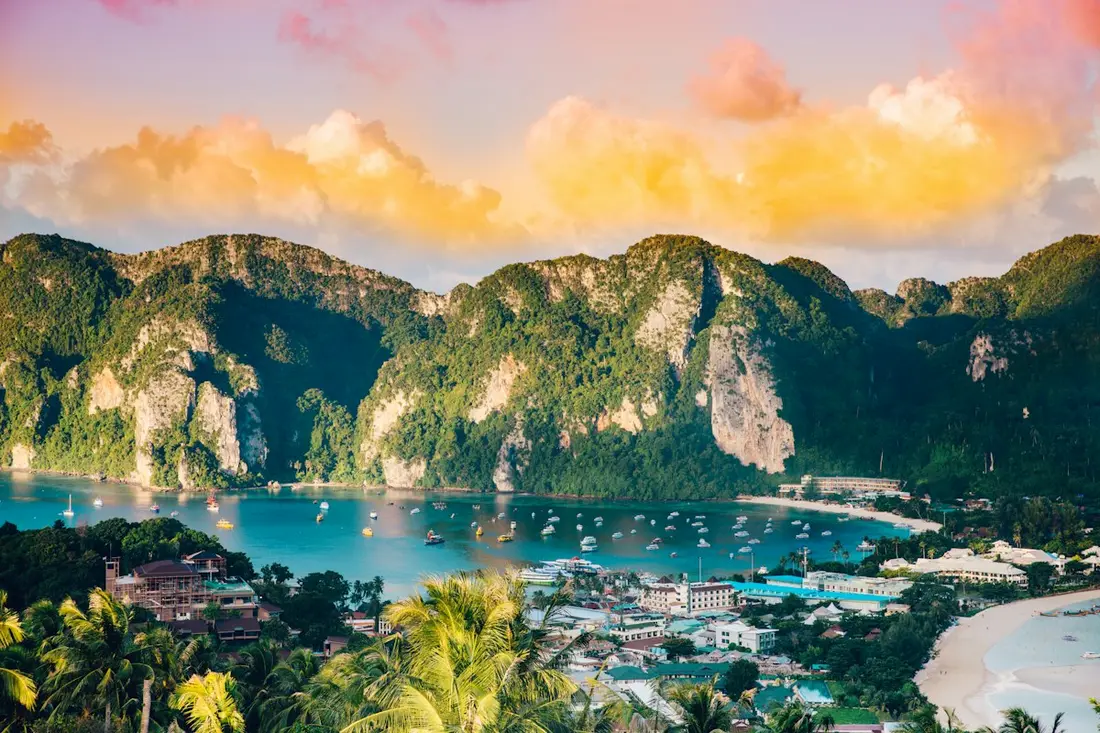
Is Thailand a safe travel destination? The short answer
Yes. Thailand is a safe travel destination for tourists, and I would say that with more conviction than the news reports might suggest. The US State Department rates it at Level 1, "take normal precautions," the same level as Japan and Australia, which were downgraded to this level in July 2026. Violent crimes against tourists are rare in Bangkok, Phuket, Chiang Mai, and the islands. What can actually harm tourists are everyday things: motorcycle accidents (the most common cause of injury and death among tourists), scams that cost money instead of safety, alcohol in party districts, and laws that are stricter than those in the US regarding the monarchy, drugs, and e-cigarettes.
Urgent travel warnings are in place for two areas: the three southernmost provinces and a strip along the Cambodian border. Neither of these are areas typically visited by tourists. The page begins with the latest news, as most people are currently asking, "What's going on?" It then answers questions for individual destinations based on the travel advisories issued by the US, UK, Australia, and Canada.
What's new and what does that mean for your trip?
Bangkok was hit by severe flooding in late September 2026. Three days of torrential rain from September 24 to 27 brought more than 300 mm of precipitation to parts of the city within 48 hours. On the morning of September 26, the city declared all 50 districts disaster areas. Four people died in Bangkok, over 200 emergency shelters were set up, 400 schools remained closed on September 28, and the government declared special holidays for Bangkok, Nonthaburi, Pathum Thani, and Samut Prakan on September 28 and 29 to allow residents to repair their homes. The water receded slowly. On October 11, approximately 329,000 households in Bangkok and parts of 21 provinces, including Ayutthaya, were still affected, although water levels were decreasing. The eastern part of the city (Lat Krabang, near Suvarnabhumi Airport) was the hardest hit. Both airports remained open. The tourism authority asked passengers to allow two to three extra hours for their journeys, and baggage handling at Suvarnabhumi Airport was delayed by several hours on September 27. The BTS and MRT subways continued to operate. The city estimates that it will take two to three days for the water to recede after the rain stops. If your trip falls in the weeks following a flood, I wouldn't cancel it. I would check with the airline the day before, book a refundable first night, and absolutely avoid wading through the water (one of the fatalities in Bangkok was electrocuted in a flooded parking lot). Phuket, Krabi, Chiang Mai, and the Gulf Islands were not affected, which is typical for Bangkok floods.
The Thai-Cambodian border is closed. All land crossings have been blocked since June 2025. The two sides clashed in July and December 2025. A ceasefire was in effect on December 27, and in September 2026, both armies continued to accuse each other of border violations. No reopening date has been announced. Travel advisories specify varying distances from the border. The UK advises against traveling within 20 km of the border except for essential journeys. Australia recommends not traveling within 10 km of Sa Kaeo, Buriram, Si Saket, Surin, Ubon Ratchathani, Chanthaburi, and mainland Trat. Canada and New Zealand recommend a distance of 50 km. The border zone is due to landmines. Temples along the border (Preah Vihear, Ta Muen Thom) are closed. If you wish to travel to Cambodia, fly. A flight from Bangkok to Siem Reap or Phnom Penh takes about an hour.
The Deep South experienced its worst night in years on August 22, 2026: 51 coordinated bombings and arson attacks occurred in 21 districts of the provinces of Yala, Pattani, and Narathiwat. Three people were injured, and a curfew was imposed in Narathiwat. The US classified the three provinces as a Level 2 alert, the UK advised against all non-essential travel there (as well as to four districts of Songkhla and along the Hat Yai–Padang Besar railway line), Australia recommended reconsidering travel, and Canada advised against travel to these areas. The Andaman Islands and the golf resorts, located 300 to 500 km away, were unaffected.
The Iran-Iraq War, which began on February 28, 2026, is affecting Thailand exclusively by air. Gulf airspace was closed in early March, Dubai's passenger traffic fell by 31% in the first half of 2026, and Gulf carriers were the hardest hit. Thailand is not involved in the war, and there have been no incidents there. While the situation persists, all travelers flying over the Gulf should have their airline's app installed and plan their itinerary flexibly; direct flights and connections to East Asia are not affected.
The following remain unchanged: the US State Department's classification as Level 1, the number of tourist police officers at 1155, the 30-day visa-free entry for 60 nationalities (shortened from 60 days on September 15, 2026), and the free Thailand Digital Arrival Card, which everyone must apply for within three days of landing.
Events are changing faster than any guidebook. The official advisories linked below are updated daily; please read them before making any changes.
These are the recommendations on which this page is based; they are all free and are updated daily by the governments themselves.
Key facts
The US State Department indicates Level 1, which involves taking normal precautionary measures.
On July 7, 2026, the risk level was lowered to Level 1, the same level as for Japan and Australia. Level 2 ("Increased Caution") applies only to two areas: the Thai-Cambodian border (risk of armed conflict, exclusion zones, unexploded ordnance) and the provinces of Yala, Pattani, and Narathiwat. Google's AI summary classifies the south as Level 3; the US State Department website lists it as Level 2.
The greatest risk is a motorcycle accident.
In Thailand, approximately 18,000 people die in road accidents each year, more than four out of five of them on motorcycles. The US State Department points out that several US citizens are killed annually on two- and three-wheeled vehicles. Wear a helmet (it's required by law), have a motorcycle license (otherwise your insurance won't cover you), and never ride after consuming alcohol.
Lèse-majesté lasts up to 15 years per count.
Insulting the monarchy is a criminal offense, including on social media, even if the posts were made before your arrival. Foreign nationals have already been prosecuted. Damaging a banknote (bearing the king's image) can also be prosecuted. Do not post anything about the royal family while you are in the country.
You can reach the tourist police on 1155, the police on 191 and the ambulance on 1669.
The number 1155 answers English-language inquiries 24/7 and is the right number for fraud reports, theft reports, and anything you prefer to explain in English. Save all three numbers before you land. Outside of major cities, ambulances are often slow; in an emergency, a taxi to the nearest private hospital is frequently faster.
E-cigarettes are illegal; cannabis is only available with a prescription.
E-cigarettes, vape pens, and refill cartridges may not be imported, sold, or possessed. Violations are punishable by fines of up to 30,000 baht and imprisonment. Since June 25, 2025, cannabis has been legal in Thailand exclusively for medical purposes. Its use requires a Thai prescription for one of five medical conditions. Public consumption is prohibited, and smuggling cannabis flowers is a criminal offense prosecuted by customs and can be punished with up to 10 years in prison and a fine of 500,000 baht.
30-day visas and a deportation regulation are new in 2026.
Visa-free entry was shortened from 60 to 30 days on September 15, 2026. A Prime Minister's decree, in effect since August 28, allows immigration authorities to deport and blacklist foreigners for "public order" offenses. In practice, this means brawls, vandalism while drunk, and disrespectful comments on social media. Just behave like you would at home, and you'll never have any problems.
What the individual governments are saying
Australia and Canada have assessed the entire country somewhat more cautiously than the US and UK for years; the difference lies in their respective approaches, not in a disagreement about Bangkok or Phuket. New Zealand also advises against travel within 50 km of the Cambodian border. None of these countries advise against travel to other popular destinations; the levels listed in this table are valid from 2026, and the links above indicate where a change would first be noticeable.
Is it safe where you're going?
The question "Is Thailand safe?" essentially becomes "Is Bangkok safe?" or "Is Phuket safe?" once you've actually traveled there. The answer depends less on the destination than you might think, but the risks certainly do. Make your choice.
Select a travel destination, and the answer will appear here.
The assessments are based on the four indicators mentioned above, the events in the 2026 protocol below, and the information on the website's landing pages. The hospitals mentioned are private clinics with English-speaking emergency departments that are open 24/7; public hospitals are good and cheaper, but may take longer for foreign nationals.
Will Thailand be a safe travel destination in 2026? The figures
Two sets of numbers are important, and they point in opposite directions. As far as crime is concerned, Thailand is quiet. According to the U.S. State Department's travel advisories, violent crimes against foreigners are rare, and all the recommendations list the same minor offenses (pickpocketing, purse snatching, cash bill fraud, rental fraud) that visitors actually experience. Millions of women traveling alone come here every year. I can leave my laptop on a café table in Chiang Mai and expect it to still be there when I get back—something I wouldn't do in most American cities.
Thailand is among the most dangerous countries in the world when it comes to roads. The World Health Organization estimates the number of traffic fatalities at 25.4 per 100,000 inhabitants (as of 2021; a more recent Thai study analyzing death certificates found 22.7 – still almost twice as high as in the US). This equates to roughly 18,000 deaths per year, with more than four out of five involving motorcyclists. This statistic should change your behavior, as most tourists who die in Thailand are killed on rented scooters, not in crimes. I list all the figures, each with its official source and year, on a separate page dedicated to safety statistics for Thailand.
In the 2026 Global Peace Index, Thailand has dropped from 86th to 101st place out of 163 countries. This is due to border conflicts with Cambodia and the insurgency in the far south of the country; both factors negatively impacting the result are largely inaccessible to tourists. Other travel guides still list the previous ranking of 86th.
Is Bangkok safe?
Bangkok is very safe. There is the usual petty crime of a large city: pickpocketing in busy markets, mobile phone thefts from passing motorbikes, taxi meters that inexplicably malfunction, and almost no violent crime like you might expect in American or European cities. There are no neighborhoods to avoid. However, caution is advised in nightlife districts after 11 pm, especially on Khao San Road, Sukhumvit Soi 11, and in the bar districts of Nana and Patpong. These areas are the main areas reported to have been drugged with date rape drugs and overcharged bills. Thanks to the BTS Skytrain, MRT, and Grab, however, the risk of being robbed while traveling is significantly reduced.
The full answer, including information on scams in Bangkok, nighttime walks, accommodations, the first flooded neighborhoods, the 2026 pub fire, and advice for solo female travelers and families, can be found in my Bangkok safety guide.
The tourist police can be reached 24 hours a day on 1155 (English). If a driver, bar, or shop tries to call you, saying the number loudly will usually end the call.
Is Phuket safe?
Phuket is safe and well-equipped for tourists, with two large private clinics, a police presence on every beach, and an economy built on satisfied visitors. Violent crimes against tourists are rare. The sea poses an often underestimated risk: from May to October, the southwest monsoon creates dangerous currents off Kata, Karon, and Patong, resulting in drownings every year. Therefore, only swim in areas with a green flag. Scooters in the hills between the beaches also pose a danger. On Bangla Road, the main reported incidents are the administration of date rape drugs and inflated bar bills. Away from Patong, the island is relaxed and family-friendly.
The full answer, including information on which beaches are safe for swimming at which time of year, information on jet ski, taxi and Bangla Road scams, Patong at night, scooter rules that may invalidate your insurance, and advice for women traveling alone and families, can be found in my Phuket safety guide.
Chiang Mai, Pai and the North
Chiang Mai is considered the safest city by solo travelers, families, and retirees, and I agree. It's compact, easy to explore on foot, and uncomplicated, with virtually no crime against visitors. The risks are more physical than criminal: the mountain roads to Doi Suthep and Pai, stray dogs, and, from mid-February to April, the smoke from the forest fire season, which is discussed in a separate section below.
The complete answer, including monthly flight prices, scooter rules that invalidate your insurance, the old town at night, recommendations for and against accommodations, floods, elephants, the Lantern Festival, and advice for solo female travelers and families, can be found in my Chiang Mai safety guide.
Chiang Rai and Pai are not affected by border warnings. The conflict in Myanmar occasionally spills over into the border districts of Tak and Mae Hong Son, and the towns infested with scammers are located on the Myanmar side near Myawaddy, opposite Mae Sot; both are outside the usual Chiang Mai–Chiang Rai–Pai travel route.
Pattaya, the islands and everywhere else
Pattaya is generally safe. Risks are concentrated in the nightlife, particularly drugging and disputes over bar tabs in Walking Street and Soi 6, pickpocketing from motorbike taxis at 2 a.m., and scooter accidents on Sukhumvit Road. Away from the bars, Pattaya is a family-friendly beach resort with a good hospital. Jomtien and Na Jomtien are even quieter. For information on bar etiquette, jet ski and baht bus scams, suitable beaches, and family-friendly accommodation, see my Pattaya Safety Guide.
Koh Samui, Koh Phangan, and Koh Tao are safe islands, with one particularly dangerous night each month. The Full Moon Party on Haad Rin draws tens of thousands of visitors, and the associated injuries are predictable: buckets studded with nails, burns from fire ropes, cuts from broken glass, and the sexual assaults specifically mentioned in Canada's travel warning. Go only with trusted individuals, buy sealed drinks, and avoid jumping over the bonfire. On the rest of the month, the biggest hazards are scooters (on Samui's ring road and Phangan's unlit hills) and the dangerous currents on the east coast during the November and December monsoon season. Koh Tao's negative tabloid reputation stems from a double murder on Sairee Beach in 2014 and a series of deaths since. In everyday life, it's a dive destination, and its risks are essentially the same: motorbikes and the ocean.
Krabi, Koh Lanta, Khao Lak, and Koh Lipe form the more relaxed part of the Andaman Sea. The risks here are the monsoon rains and the distance to hospitals. Koh Chang and Koh Samet are considered safe. The border strip on the mainland of Trat lies within the Australian 10-km zone, and the Hat Lek border crossing into Cambodia is closed. However, the islands are far enough away from both. Hua Hin is the safest beach resort in the country. The cities in Isan are as safe as anywhere else in Thailand. The border strip in Buriram, Surin, Si Saket, and Ubon should be avoided. Phanom Rung, the temple for which many pilgrimage to Buriram, is about 30 km from the border, outside the Australian and British zones but within the Canadian 50-km zone. Therefore, check your country's border regulations before visiting the temple.
Is Thailand safe for women traveling alone?
Thailand is one of the most popular travel destinations for solo female travelers worldwide, and for good reason. Millions of women travel there alone each year; Thai culture is respectful towards women, and thanks to the well-developed infrastructure for backpackers and digital nomads, you're never the only solo traveler in your hotel room. Chiang Mai is considered by most women to be the safest and most pleasant city; Bangkok, Koh Lanta, Pai, and the quieter beaches of Koh Phangan are also excellent alternatives.
The precautions are the same as anywhere else, with two specific points for Thailand. In party districts and at the Full Moon Party, do not accept drinks or leave them unattended, as date rape drugs are a common form of sexual assault there. At night, use Grab or Bolt instead of a taxi or motorbike taxi, as the app records the driver. The Thai police often react slowly and unsympathetically to reports of sexual assault; in this case, contact the Tourist Police (1155) and your embassy. The solo tour guide will address all these points city by city.
Common scams in Thailand and how to avoid them
The gemstone fraud and the "The temple is closed" scam.
A friendly stranger near the Grand Palace or Wat Pho claims it's closed today (which isn't true) and offers you a cheap tuk-tuk tour instead. The tour includes a visit to a supposed state-run gem shop or "export promotion" with special prices. The gems offered are worthless. If a temple looks open, it is; if a stranger offers you a bargain, walk away.
The detour via the 20-pound tuk-tuk and the tailor
Dirt-cheap rides around Bangkok are available in exchange for a visit to the tailor. The suits are overpriced and of poor quality. Use Grab or hail a metered taxi and say "meter please"; a driver who refuses will be replaced by the next one.
Damage to jet skis and motorcycles
You return the vehicle, and the owner discovers damage that was already present. He demands thousands of baht and keeps your passport. To avoid this, photograph and film the vehicle before taking possession, never leave your passport as collateral (the Foreign Office also advises this), and rent from a provider recommended by your hotel. The Tourist Police, reachable at 1155, have dealt with thousands of such cases.
Drink poisoning and the bar bill
Reports have covered Khao San Road in Patong, Walking Street in Pattaya, and the Full Moon Party. Pay attention to how your drink is poured, carry it yourself, and avoid buckets of mixed drinks you haven't seen. Fraudulent bar bills are common: you'll receive a bill many times the amount you drank, and a large man will be standing by the door. Pay by card whenever possible, keep track of your spending, and call 1155 instead of arguing.
ATM skimming and "conversion"
Use ATMs in bank branches or shopping malls, cover the keypad, and decline dynamic currency conversion (this is always more expensive). Thai ATMs charge 250–350 baht per withdrawal with foreign cards. Therefore, it's better to withdraw cash more frequently.
Fake arrival card websites
The digital entry card for Thailand is free and can only be applied for at tdac.immigration.go.th. Websites demanding $20 to $50 for "processing" are the latest scam in Thailand, and Australia is now explicitly warning against them. If a website asks for your card number, it is a fake site.
The harmless card game and the love deception
A local family invites you to their home, a cousin teaches you a card game, and you leave with thousands of dollars in debt. Online, a relationship turns into a money-making scheme. The U.S. State Department cites romance fraud, investment fraud, and job offer fraud as the scams that cost Americans the most in this country; none of them involve a stranger who wants nothing.
Job offers that end in a fraud scheme
The most dangerous scam in the region, while not targeting tourists, should still be known. Online advertisements for "customer service" jobs lead to secluded compoundes across the border in Myanmar or Cambodia, where the victims defraud others. They fly legally to Bangkok and are then taken to Mae Sot or Poipet. Warning signs in three languages at the Thai checkpoints on the road to Mae Sot alert you to this. No reputable employer will pick you up at the airport for a job for which you haven't had an interview.
Health, food and water
Street food is safe
High turnover means freshly prepared food. Choose the stall with the longest queue, especially for Thai dishes, and avoid food that has been sitting out in the sun for a while. Ice in restaurants and bars is industrially produced from purified water and is safe to eat.
Do not drink tap water.
Bottled water costs between 7 and 15 baht and is available everywhere. Most hotels provide two free bottles daily. Brushing your teeth with tap water is safe. However, drinking it in large gulps is not.
Heat is the health risk that people are actually exposed to.
Heat exhaustion leads to more doctor visits among tourists than any other illness. Drink three to four liters of water daily, use sunscreen with SPF 50, and avoid the ruins during the midday heat from March to May, when temperatures in Bangkok, Ayutthaya, and Sukhothai reach 38–40 °C.
Dengue fever and other mosquito diseases
Dengue fever occurs year-round, peaking during the rainy season from June to October. Using DEET-based insect repellent at dusk and dawn is the only prevention; there is no standard vaccination for tourists. High fever accompanied by joint pain several days after a bite necessitates a visit to a private clinic, where a dengue test costs several hundred baht. Malaria is found only in remote border areas, not in tourist regions.
Rabies is present here, so do not touch the dogs or the monkeys.
Rabies is present in Thailand, mainly in stray dogs and temple and beach monkeys. Australia's travel warning is unequivocal: never feed, pet, or tease a monkey. After a bite or scratch, the wound should be rinsed for 15 minutes, and post-exposure prophylaxis (PEP) should be administered at a hospital the same day. The vaccination is inexpensive and effective, and the disease is fatal once symptoms appear. If you are traveling to rural areas or undertaking trekking tours, it is advisable to consult a travel health clinic about PEP.
Air quality, February to April
In northern Thailand, the slash-and-burn season shrouds Chiang Mai, Chiang Rai, and Pai in smoke from mid-February to April, with the worst of it occurring in March. Bangkok is also affected by haze from December to February. Check with IQAir before booking a trip to the north during these months and read the section below.
The hospitals are excellent, and they want to be paid first.
Bumrungrad Hospital in Bangkok treats over half a million international patients annually, and there is a branch of Bangkok Hospital in every resort town. Private clinics require a card or insurance guarantee before admission, and a one-week stay can cost five figures. Most medications are available over the counter at pharmacies, but some prescription drugs that are legal in your home country (certain ADHD and pain medications) are subject to Thai drug control. Therefore, bring your prescription and check the Thai Drug Administration (Thai FDA) list before packing any medications.
The fire season and air quality in the north
From mid-February to April, farmers in northern Thailand, Laos, and Myanmar burn rice straw, sugarcane, and cornfields. Forest fires exacerbate the situation, and the smoke accumulates in the mountain valleys around Chiang Mai, Chiang Rai, and Pai. March is invariably the worst month. In March 2026, Chiang Mai was considered the most polluted city in the world on several days. On March 30, the particulate matter (PM2.5) concentration reached 188 micrograms per cubic meter—about twelve times the 24-hour limit recommended by the WHO. The air quality index was 263, placing it in the "very unhealthy" category.
For visitors, it usually means a sore throat and burning eyes, and poses a real risk to people with asthma, heart or lung conditions, young children, and pregnant women. Views of Doi Suthep are then obscured. If the north is your destination, the best time to travel is between November and January, when the air is clear and the nights are cool. If March is your only option, it's advisable to stay on the coast and plan a short two-night trip to the north. Check prices daily on IQAir and bring N95 masks, which are available at any 7-Eleven during the season. The smog in Bangkok, caused more by traffic and dust than by fires, persists from December to February and is milder.
Transport safety on roads, railways, ships and airplanes
Motorcycles are by far the most common cause of accidents involving tourists in Thailand. If you ride a motorcycle, always wear a helmet (this is mandatory by law, but only sporadically enforced, and can mean the difference between a minor or fatal accident), carry your motorcycle license with you (without it, your travel insurance won't cover you, and the Thai police will fine you), don't drink alcohol, and don't ride a motorcycle you wouldn't ride at home. If you're not an experienced rider, don't practice in the hills of Phuket, on Koh Chang mountain, on Pai Road, or in Bangkok traffic. A ride-hailing service like Grab or Bolt will cost less than a night in the hospital.
Trains and domestic flights are safe. Thai airlines meet FAA international safety standards, and while slow and inexpensive, the state railway's long-distance trains are considered one of the safest ways to cross the country. An exception was the tragic accident in May 2026 when a freight train struck a bus stopped at the Makkasan level crossing in Bangkok, killing eight people. The bus had driven onto the tracks in a traffic jam, and the barriers failed to close. If you are in a taxi or bus, do not ask the driver to stop at a level crossing. Long-distance buses vary. State-run and VIP buses from the main terminals are generally safe; however, the cheapest night buses, often found on Khao San Road, are known for frequent luggage thefts.
Boat connections range from excellent (Lomprayah, Seatran, and the large ferries between the Gulf islands) to overcrowded longtail boats in rough seas. Before island hopping during the monsoon season (May to October on the Andaman side, October to December on the Gulf side), check the weather forecast, book with licensed operators, and count the life jackets before setting off. A captain who cancels a trip in rough seas is a sure sign of a bad captain.
Thai laws that tourists should know
Lèse-majesté (§ 112) will be strictly enforced.
Insults, defamation, or threats against the monarchy are punishable by up to 15 years in prison per offense. This also applies to social media posts, conversations, gestures, and content published before your arrival. Foreign nationals have already been prosecuted and imprisoned. During your stay in Thailand, do not post anything about the royal family, stand for the national anthem at 8:00 a.m. and 6:00 p.m. in public and before film screenings, and do not damage or crush banknotes.
Drug penalties are among the strictest in the world.
Possession of hard drugs can lead to years in prison, and drug trafficking can even result in death. Cannabis was decriminalized in 2022, but on June 25, 2025, its use was again restricted to medical purposes. A Thai prescription covering one of five indications is required for consumption. Public consumption is prohibited (three months in prison and a 25,000 baht fine), while recreational use is punishable by up to one year in prison and a 20,000 baht fine. Importing cannabis flowers through customs is considered smuggling and can be punished with up to ten years in prison and a 500,000 baht fine. By early 2026, approximately 7,000 of the 18,000 dispensaries had closed. Drug tests in clubs and at the Full Moon Party are becoming increasingly common.
E-cigarettes and vaping are prohibited.
The import, sale, and possession of e-cigarettes, vapes, and refill liquids are prohibited. Violators are punishable by fines of up to 30,000 baht and imprisonment. Customs officials inspect luggage. Smoking on a growing number of beaches (including Patong, Hua Hin, and Bang Saen) can result in a fine of up to 100,000 baht. Leave your e-cigarette at home.
The law against defamation means that a bad review can constitute a criminal offense.
In Thailand, defamation is a crime, and foreigners have been arrested for posting negative online reviews of hotels and restaurants. Complain to the respective business and your booking platform; do not publicly call anyone a thief.
Clothing and behavior in the temple
Shoulders and knees must be covered, shoes removed indoors, feet must never be pointed at a Buddha statue, and women may not directly hand objects to or touch monks. The Grand Palace does not accept visitors; bring a sarong. Photography is permitted unless otherwise indicated by a sign; tourists caught climbing on things for a photo have been expelled.
Carry your identification with you and be aware of the deportation regulations from 2026.
Carry a copy of your passport's photo page and entry stamp with you (the original remains in the safe); otherwise, the police may detain you. Since August 28, 2026, a Prime Minister's decree allows authorities to revoke the visas, deport, and blacklist foreigners who break the law or endanger public order. Previous cases have involved brawls, property damage while intoxicated, and disrespectful behavior in temples. Overstaying your visa incurs a daily fine, and after more than 90 days, you will be banned from entering the country.
Methanol, knockout drops and alcohol
Methanol poisoning from adulterated alcohol claims the lives of tourists in Southeast Asia almost every year. In November 2024, six visitors died in Vang Vieng, Laos; in Thailand, a batch of adulterated spirits caused at least six deaths and hospitalized more than 20 people in August 2024. Australia and the UK subsequently added methanol warnings to their Thailand websites. Methanol is industrial alcohol used in place of ethanol in cheap, moonshine and counterfeit branded spirits. It tastes the same and causes blindness, organ failure, and death within hours to days.
To prevent methanol poisoning, drink beer, wine, and branded spirits only from sealed bottles that you have seen opened, and only in established bars. Avoid free drink buckets at beach parties, moonshine in hostels, and anything offered in suspiciously cheap establishments. Symptoms such as severe headaches, blurred vision, nausea, confusion, and shortness of breath appear 6 to 24 hours after alcohol consumption and are therefore often mistaken for a hangover. Seek immediate medical attention at a private hospital if you experience visual disturbances; methanol poisoning is highly treatable in its early stages.
The drugging of drinks with date rape drugs is another, more common problem reported in Patong, Khao San Road, Walking Street in Pattaya, and at the Full Moon Party. Watch your drink being prepared, never leave it unattended, and don't accept drinks from strangers. The same rules apply as in any other nightlife district in the world; the only difference is that here, the drink might consist of a bucket with six straws.
If you suspect methanol poisoning, please go immediately to a large private hospital, such as Bumrungrad Hospital or Bangkok Hospital in Bangkok, Bangkok Hospital in Phuket, or Bangkok Hospital in Samui. Treatment requires prompt action. The Tourist Police can be reached at 1155.
Current events and what each one means for you
Most security websites either act as if nothing is happening in Thailand or list every headline as if it were a warning. Here is the current overview with the respective impacts.
On March 28, 2025, an earthquake struck Myanmar. A magnitude 7.7 quake near Mandalay shook Bangkok, 1,000 km away. A 30-story tower under construction for the State Audit Office in Chatuchak collapsed, killing 96 workers. The investigation blamed the design of the elevator and stairwell core, not the steel. All other buildings in the city remained intact. This doesn't change the situation on the ground, and the honest explanation for "Thailand is not in an earthquake zone" is: "Bangkok's soft soil amplifies distant earthquakes, and its modern buildings are designed to withstand this."
On May 16, 2026, a freight train accident occurred at the Makkasan level crossing when a city bus had stopped on the tracks in Bangkok; eight people died. As a result, vehicles will no longer be allowed to stop on railway tracks. It was also revealed that the train driver tested positive for methamphetamine and was charged – an example supporting the US State Department's claim that professional drivers frequently consume alcohol and stimulants.
On July 12, 2026, a fire broke out at the Lat Phrao pub. An electrical fault in a beer hall near Chatuchak claimed 41 lives, most of them trapped in windowless toilets because the back exits were blocked. The lesson learned: in every bar, club, or hostel, always check the second exit before sitting down. Thailand's fire safety oversight is inadequate, and this was the second fatal fire in the nightlife sector within four years, following the Mountain B pub fire in Chonburi in August 2022.
August 22, 2026, Deep South. 51 coordinated bombings and arson attacks in Yala, Pattani, and Narathiwat in a single night; three injured, curfew imposed. Nothing changes for tourists, as no tourist route leads there; therefore, all travel warnings remain in effect for the three provinces.
On August 28, 2026, the new deportation regulations came into effect. Immigration authorities can now deport foreigners for public order offenses without a criminal conviction and place them on an entry ban list. The change means that a drunk tourist who kicks an entry gate or climbs a temple wall must now leave the country within the same week.
The visa reduction came into effect on September 15, 2026. Visa-free entry was shortened from 60 to 30 days. While security remains unchanged, everything changes for travel planning: extending a visa now costs 1,900 baht.
From September 24th to 27th, 2026, Bangkok experienced flooding. It rained continuously for three days, all 50 districts were declared disaster areas, four people died in Bangkok, yet the airports remained open. As a result, bookings for September and October in eastern Bangkok must be refundable, and the honest answer to the statement "floods rarely affect tourists" is: "For a decade they didn't, and then they did."
And the border. The war with Cambodia in 2025 claimed dozens of lives, displaced hundreds of thousands, closed all land crossings, and left mines along the border; the ceasefire from December holds, however, border violations occur on both sides in September 2026. The change is that when flying to Cambodia, the 10- to 50-km zone indicated in travel warnings is now considered a real-world situation.
Floods, storms, earthquakes and tsunamis
Thailand's natural hazards are seasonal and largely predictable. Monsoon floods hit Bangkok, the central plains, and the south from May to October, with the worst occurring in September and October. The floods of September 2026 demonstrated that even a modern city can be submerged for weeks. The riverside ruins of Ayutthaya are flooded during rainy Octobers. Tropical storms from the Gulf bring flooding and storm surges to Koh Samui, Hua Hin, and the east coast from October to December; the rough season on the Andaman coast lasts from May to October. Landslides in the mountains of the north and south, following heavy rainfall, are mentioned in all warnings.
Thailand lies along the region's fault lines, but not directly on them. The 2025 Myanmar earthquake was the first in living memory to cause fatalities in Bangkok. Modern high-rise buildings are constructed to earthquake safety standards, and the collapsed building had structural defects. Tsunamis are possible on the Andaman coast, but rare. The 2004 disaster led to the establishment of a warning system with sirens and marked evacuation routes along all west coast beaches, as well as monthly siren tests. Just memorize the route from your hotel and you won't have to worry.
Three honest videos on the topic of security here
Footage from other travelers, chosen because each one addresses a risk that can only be described on this page: scams between the airport and the city, why the roads pose the real danger, and what the events of 2026 will look like for someone living in Bangkok.
Security according to traveler type
Families with children
Thailand is an excellent destination for families, and the Thai people are very child-friendly. Hua Hin, Kamala, and Bang Tao in Phuket, Ao Nang in Krabi, Koh Lanta, and Chiang Mai (outside of fire season) are good starting points. The biggest risks are the sun and dogs, so make sure your children drink plenty of fluids and stay in the shade at midday. Teach them to keep away from stray animals and monkeys. Baby items are available at any 7-Eleven.
LGBTQ+ travelers
Bangkok is the most LGBTQ+ friendly country in Southeast Asia, where same-sex marriage has been legal since January 2025. The nightlife is centered around Sois Silom 2 and 4, same-sex couples are a common sight in hotels, and transgender people are a visible part of everyday life. The British travel advisory describes Bangkok as "generally safe for LGBTQ+ travelers," and I would remove the "generally."
Backpackers and budget travelers
The route is well-trodden and safe. Use the lockers in hostels, keep your bags on your lap on night buses, and be especially careful at the Full Moon Parties (book your accommodation away from Haad Rin; thefts are common there). Pad Thai from a street vendor at 2 a.m. is safe and likely to be excellent.
Older travelers and pensioners
Thailand is popular with retirees due to its hospitals, low cost of living, and a culture that respects the elderly. Risks include infrastructure issues, broken sidewalks, pedestrian crossings with only warning signs, and stairs everywhere. The BTS and MRT are wheelchair accessible; book airport transfers and use Grab instead of struggling with songthaews. Check if your insurance covers you beyond age 70; many travel health insurance policies end at 69.
American
Level 1 U.S. State Department offices, a large embassy on Wireless Road (+66 2 205 4000, open 24 hours), and a consulate in Chiang Mai. Register with STEP, carry a copy of your passport, and be aware that Medicare does not cover treatment abroad and Thai hospitals require a card before treatment. Therefore, medical evacuation insurance is essential. See the U.S. Visa Guide for entry requirements.
Related instructions can be found on this website.
Frequently Asked Questions
Frequently asked questions on the topic: Is Thailand safe?
Yes. The US State Department rates Thailand at Level 1, "Exercise normal precautions," the lowest level, which was downgraded on July 7, 2026. Violent crimes against tourists are rare. The risks that actually endanger tourists are motorcycle accidents, scams, being given date rape drugs in party districts, and the strict laws regarding the monarchy, drugs, and e-cigarettes. Travel warnings are in place for two areas: the southern provinces and the Cambodian border strip, both of which are not near tourist destinations.
Yes. No government is advising against travel to Bangkok or other resort areas. The Cambodian land border is closed, and the usual travel warnings are in place for the far south; however, neither of these factors affects normal travel plans. The last disruption was the flooding in Bangkok from September 24–27, 2026, when all 50 districts were declared disaster areas and parts of the city were still underwater in October, although the airports remained open. The news articles at the top of this page and the official travel advice linked there will keep you updated on the current situation.
Only by air. The war, which began on February 28, 2026, led to the closure of airspace over the Gulf in early March and has since affected services operated by Emirates, Qatar Airways, and Etihad. Dubai's passenger traffic fell by 31% in the first half of 2026. Thailand is unaffected; there have been no incidents there, and direct flights and connections to East Asia are unaffected. If you are flying over the Gulf, plan your itinerary flexibly and install your airline's app.
Yes. The U.S. State Department's Level 1 rating is the same as for Japan and Australia and lower than that of France, Germany, or Italy (Level 2). U.S. citizens are simply advised to exercise increased caution near the Cambodian border and in Yala, Pattani, and Narathiwat, and are asked to observe lèse-majesté and drug-related laws. Enroll in the STEP program, carry a copy of your passport, and purchase travel health insurance with repatriation coverage; Medicare does not provide coverage abroad.
No. The UK's red list was a COVID-era regulation that expired in March 2022 and is no longer in effect. The UK Foreign and Commonwealth Office (FCDO) only advises against travel to Yala, Pattani and Narathiwat, four districts of Songkhla, along the Hat Yai–Padang Besar railway line, and areas within 20 km of the Cambodian border, except in urgent cases. There is no travel warning for Bangkok, Phuket, Chiang Mai, or the islands.
No government is like this. The headlines for 2026 were the Bangkok floods, the closed Cambodian border, the attacks in the far south on August 22, the reduction of visa duration to 30 days, and a new deportation policy for tourists with unruly behavior. None of the travel advisories advise against traveling to specific destinations. Australia and Canada recommend "high caution" for the entire country, the same advice they have been issuing for Thailand for years.
Generally speaking, yes. Bangkok's city center remains busy even after midnight, the BTS and MRT are safe at any time of day or night, and the main streets are well-lit and lively. However, caution is advised in nightlife districts after 11 pm, particularly in Khao San Road, Sukhumvit Soi 11, Nana, and Patpong, where date rape drugs and inflated bar bills are common. At night, it's best to use Grab rather than a taxi.
Yes. Phuket has two large private clinics, a police presence on every beach, and a well-developed tourist infrastructure. Risks include dangerous currents in Kata, Karon, and Patong from May to October (swimming is only permitted under green flag conditions), scooter accidents on the mountain roads, and scams in the Bangla Road nightlife. Outside of Patong, the island is relaxed and family-friendly.
Yes. Thailand is one of the most popular destinations for solo female travelers worldwide, with millions of women traveling there alone each year. Chiang Mai is consistently ranked as the safest city. In party districts, avoid accepting and leaving drinks unattended, use Grab at night, and consider the Full Moon Party the only night with increased risk. The guidebook for solo female travelers provides detailed information for each city.
Motorcycle accidents are by far the most common cause of death. Thailand loses approximately 18,000 people to road traffic accidents each year, more than four out of five of whom are motorcyclists. The US State Department points out that several people also die in motorcycle accidents in the US every year. Anyone riding a motorcycle should absolutely wear a helmet, have a motorcycle license (otherwise insurance won't pay out), and never drink alcohol. Inexperienced riders should consider using a ride-hailing service like Grab or a private driver.
Secondly, the southernmost provinces of Yala, Pattani, and Narathiwat (as well as parts of Songkhla, according to the UK and Canada), where an insurgency is ongoing and 51 attacks were carried out in a single night on August 22, 2026; and the strip of land along the Cambodian border, closed and mined since 2025, which, according to warnings, is 10 to 50 km wide. Neither area is near tourist destinations. Bangkok, Chiang Mai, Phuket, Krabi, and the islands are not subject to travel restrictions.
No. All border crossings, including Aranyaprathet-Poipet and Hat Lek, have been closed since June 2025, and the Thai government announced in 2026 that there is no reopening date yet. Fly instead. Flights from Bangkok to Siem Reap or Phnom Penh take about an hour and are inexpensive. The border strip itself is classified as a "no-travel area" in most travel advisories due to landmines.
Yes. Red and yellow acquired political significance during the protests of the 2000s and 2010s, but no one assumes that a foreigner wearing a red T-shirt has taken sides. Red is also the color of Sunday and is considered lucky by Thai-Chinese families. The only dress code that really matters is for temples: shoulders and knees must be covered.
The Digital Entry Card for Thailand (TDAC) can be applied for online free of charge by all visitors within three days of arrival (the day of arrival counts). It will replace the paper entry card from 2025, can be completed in five minutes at tdac.immigration.go.th, and is not officially recognized by any other website. The TDAC guide on the website explains all the fields.
Street food is fine, provided you choose a busy stall and avoid sitting in the sun. Tap water isn't safe, but bottled water costs between 7 and 15 baht everywhere. Ice is industrially produced and perfectly fine, and you can safely brush your teeth with tap water.
Yes. Thais love children, and the family-friendly areas (Hua Hin, Kamala, and Bang Tao in Phuket; Ao Nang, Koh Lanta, and Chiang Mai outside of fire season) are among the safest places in the country. The dangers for children are the sun, heat, and animals. Therefore, they should stay in the shade at midday, drink plenty of fluids, and avoid touching dogs and monkeys, as rabies is present.
In principle, yes. Thai private clinics are excellent and require a card or insurance guarantee before treatment. A serious motorcycle accident can cost tens of thousands of dollars. Insurance including medical evacuation, motorcycle insurance (valid only with a motorcycle license), and theft protection costs between $30 and $50 for a two-week trip. The insurance guide compares current offers.
Yes, it's comfortable, even on a mid-range trip; the cost index on this page calculates the daily prices for each destination. The best part is: many of the cheap Thailand deals can be saved on two things that are usually quite expensive: the scooter for 200 baht per day and the bucket for 100 baht. Invest your money in a Grab app and a well-sealed bottle instead.
Where to stay in Thailand
Compare prices on different trusted booking sites for the destinations listed in this travel guide.
Compare prices on Booking.com
We may receive a commission for bookings made through these links – this will not incur any additional costs for you. Learn more.
You might also like this
Best time to travel to Thailand
The best time to travel is from November to February; the rest of the year is best on the east coast.
Thailand on a budget
Thailand for less money, without sacrificing the best
Thailand Visa and Entry Requirements
Who is allowed to enter visa-free, what entry controls are in place, what is the TDAC, and how can you extend your stay?
Ethical elephant sanctuaries in Chiang Mai
No riding, no shows, and the protected areas where you watch rather than wash.
Elephant sanctuaries on Koh Samui
Five protected areas where horseback riding is prohibited, and one clear favorite.
I lived in Bangkok for four years and traveled throughout the country from there. The guidebooks reflect my personal opinion and are written as I would explain things to a friend planning a trip.
Ready to create your travel itinerary?
Use our free trip planner to save places, organize days, and share your trip.




Community
Comments 0
Start the conversation.