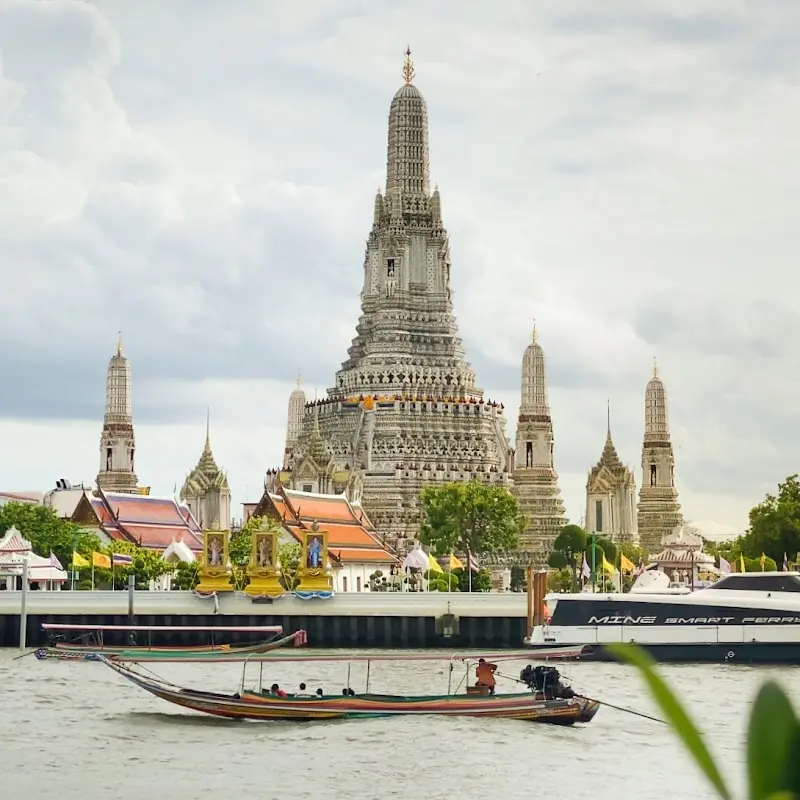
Is Bangkok a safe travel destination? The short answer
Yes. Bangkok is safe for tourists, and violent crimes against visitors are rare. The US State Department rates Thailand at Level 1, the lowest level, and none of the travel advisories from the US, UK, Australia, or Canada recommend any specific area of Bangkok to avoid. The problems that do arise are the usual big-city issues: traffic, some known scams, mobile phone theft, and the administration of date rape drugs and inflated bills in bars and pubs.
I lived in Bangkok for several years, first in the Rama 9 and Huai Khwang area, and later in Lak Song. I used the MRT almost daily, and the tips on this page will ensure that your visit remains pleasantly exciting. Use the BTS, MRT, and Grab, insist on the meter being used, and save the Tourist Police number: 1155.
Where to stay in Bangkok
This route ends in Bangkok. Search for hotels in Bangkok for your travel dates or narrow your search to a specific region. Filter for hotels with free cancellation if you'd like to book a room and decide later.
Open Booking.com with your travel dates · also on Expedia · Trip.com
My picks in Bangkok in every price category
Key facts
Consulting level
The US State Department's Level 1 alert level, "take normal precautions," was downgraded in July 2026. The two Level 2 zones are the far south and the Cambodian border, hundreds of kilometers from Bangkok.
Who should I call?
The Tourist Police can be reached at 1155 (English-speaking, available 24 hours). In case of a medical emergency, please go directly to Bumrungrad (Sukhumvit Soi 3) or Bangkok Hospital (New Phetchaburi Road). Both have English-speaking emergency rooms staffed around the clock.
locomotion
Rides on the BTS and MRT cost between 17 and 65 baht and are safe at any time of day. Grab and Bolt set the fare in their apps. Metered taxis start at 35 baht; just say "meter, please".
Water and food
Tap water should not be drunk; bottled water costs 7–15 baht. Ice cubes from street food and restaurants are fine.
Seasonal risks
Heat of 38–40°C from March to May, haze from December to February, dengue fever and flooding during the rainy season from June to October.
Is Bangkok currently safe?
Yes, and three events from 2026 are worth mentioning, as they influenced my recommendation, though not the answer itself. Bangkok was flooded from September 24th to 27th, 2026. Within 48 hours, parts of the city received over 300 mm of rain, and all 50 districts were declared disaster areas. Four people died in Bangkok. The eastern part of the city, Lat Krabang near Suvarnabhumi, was the hardest hit, and it was still raining on October 11th. Both airports remained open, and the BTS and MRT subways continued to operate. If your trip falls during the September-October rainy season, book a refundable first night, check with your airline the day before, and avoid wading through floodwaters (one of the fatalities in Bangkok was electrocuted in a flooded parking lot).
On July 12, 2026, a fire at the Rong Beer Na Lat Phrao pub killed 41 people, most of them trapped because the rear exits were unusable. Check for the secondary escape route in any bar or club in Bangkok before ordering. And on May 16, 2026, a freight train collided with a city bus that had stopped in traffic at the Makkasan level crossing, killing eight people. Therefore, never allow a driver to stop on the tracks.
None of these cases reached the warning level. More up-to-date information can be found in the official alerts below, which are updated daily. The National Security Guide also provides an ongoing overview of current developments.
The official travel advice, free of charge and updated by the governments themselves.
What's really going wrong in Bangkok
Bangkok exhibits the petty crime typical of large cities and is significantly less affected by the violent crime that visitors from American or European metropolises might expect. The British Foreign Office clarifies that violent crimes, including firearm offenses, rarely affect tourists. Reports of such crimes include pickpocketing in busy markets, mobile phone thefts from passing motorbikes, taxis whose meters inexplicably malfunction, and late-night incidents where drinks are spiked with date rape drugs and customers are charged many times the actual amount consumed.
Most nighttime crimes are concentrated in three areas: Khao San Road, Sukhumvit Soi 11, and the bar districts of Nana and Patpong. The Australian travel portal Smartraveller advises travelers to be especially careful in tourist areas like Khao San Road and Sukhumvit Road – which includes the aforementioned locations. While these are certainly pleasant places to spend an evening, after about 11:00 PM it's recommended to bring your own drinks, watch the bar staff pouring your drinks, keep track of the bill, and pay by card whenever possible.
What actually lands visitors in the hospital is road traffic. Cross major roads at pedestrian bridges or traffic lights, look both ways in one-way streets, as motorbikes often drive against the flow of traffic and on the sidewalk, and don't learn how to ride scooters in Bangkok. The US State Department specifically points to Sukhumvit Road and Wireless Road, where there have already been fatal accidents involving pedestrians.
Scams in Bangkok and how to avoid them
The Grand Palace is closed today.
A friendly stranger near the Grand Palace, or Wat Pho, claims it's closed (which isn't true) and instead offers a cheap tuk-tuk tour that ends at a supposedly government-run gem shop selling worthless stones. If a temple looks open, it is. Just go to the gate and see for yourself.
The ฿20 Tuk-Tuk
An absurdly cheap ride across town, where a tailor or jeweler stops along the way for the driver to collect a commission. Agree on the price and destination before starting the journey and state that you don't want to stop. For longer distances, Grab is cheaper anyway.
The taxi without a taximeter
A driver quotes a fixed price instead of using the meter, and this price is always many times higher than the regular fare. Accepting the negotiated price is a typical beginner's mistake that I would warn against. Say "Please use the meter," and if he refuses, the next taxi will use it. In my experience, the official taxi rank at airports is always equipped with a meter and is straightforward, with a 50 baht surcharge plus toll fees.
Drink poisoning and excessive cash bills
Reports on Khao San Road, Soi 11, and the bar districts of Nana and Patpong. Pay attention to how your drink is poured, don't put it down, and don't order drinks whose preparation you haven't witnessed. If the bill is many times the price of what you drank, pay by card if possible and call 1155 instead of arguing at the door.
ATM skimming and conversion
When using ATMs in bank branches or shopping malls, cover the keypad and decline the currency conversion offered by the ATM, as this is always more expensive. Thai ATMs charge 250–350 baht per withdrawal with foreign cards. Therefore, it's better to withdraw cash more frequently.
Fake arrival card websites
The digital entry card for Thailand is available free of charge at tdac.immigration.go.th. Websites charging $20 to $50 for "processing" are scams, and Australia warns of this in its travel advice.
The card game and the job offer
A friendly family invites you to their home, and a cousin teaches you a card game that you lose. The darker version is an online "customer service" job where you're picked up at the airport and taken to a scam facility across the border. No reputable employer would pick you up for a position you haven't been interviewed for.
Is it safe to walk around Bangkok at night?
Yes. Bangkok is still lively at midnight, and Silom, Sathorn, Sukhumvit, Ari, Chinatown, and the Old City are easily explored on foot until late at night. There's no area to avoid after dark. From around 11:00 PM, visitors head to the bar districts and then home. It's often cheaper to take a taxi using Grab or Bolt, which you can hail in front of a bar, as the apps identify the driver and fix the price.
Alcohol sales in stores end at midnight. Since May 29, 2026, sales are permitted nationwide from 11:00 PM to midnight. Exceptions include licensed bars, hotels, and late-night courts, which may remain open until 4:00 AM. As the MRT and BTS cease operation around midnight, it is recommended to take a taxi (e.g., Grab) for the last trip home rather than walking along the main street.
Traveling safely in Bangkok
The prices are taken from the Bangkok travel guides and airport information on this website. I mainly traveled by MRT, then walked or transferred to the BTS, used Grab when a destination wasn't within walking distance of a station, and used motorbike taxis primarily for journeys to and from stations in the inner alleys (sois).
Where to stay in Bangkok and where you should avoid staying
No part of central Bangkok is unsafe. The choice depends on noise levels and convenience. Those staying on Khao San Road, Sukhumvit Soi 11, or directly in the Nana district will experience music until late at night and have the vibrant atmosphere of the bars right on their doorstep. So, if you're looking for both nightlife and peace and quiet, you should stay a few streets away and walk. Proximity to a BTS or MRT station is the best criterion when searching for a hotel, as it ensures a safe and affordable way to get home at any time.
For bookings in September and October, the floods of September 2026 showed that the eastern districts near Suvarnabhumi, particularly Lat Krabang, were flooded first, while the central BTS corridor remained dry the longest. Therefore, the first night in these months should be refundable.
The best-rated hotels in Bangkok
Here is my ranking of the 10 best hotels in Bangkok. Each button will take you directly to the hotel's page on Booking.com, where you have already entered your travel dates.
Is Bangkok safe for women traveling alone?
Yes. Thailand is one of the most popular destinations for solo female travelers worldwide, and Bangkok is one of the easiest cities to navigate. Thai culture is respectful towards women, and you'll rarely be the only solo traveler in a hostel or on a day tour. The two most important tips for Bangkok generally apply to all travelers, but are even more crucial here. Don't accept drinks or leave them unattended in bars. At night, use Grab or Bolt rather than a taxi or motorbike taxi, as the app records the driver.
Should a serious incident occur, the Thai police may be slow to respond to reports of sexual assault. Call the Tourist Police on 1155 and your embassy. The solo tour guide will cover the rest of the country.
Is Bangkok safe for families and children?
Yes. The dangers for children are the heat, traffic, and stray animals, not crime. From March to May, temperatures reach 38–40°C (100–104°F). Therefore, plan temple and market visits for early morning, spend midday in a shopping mall, museum, or by the hotel pool, and ensure everyone drinks plenty of water. Use public transportation (BTS, MRT, and Grab) instead of walking on main roads, and hold hands at intersections, as motorbikes don't always stop there.
Rabies is present in Thailand, especially among stray dogs. Children should therefore be taught not to pet stray dogs or feed temple monkeys. In case of a bite or scratch, the affected area should be washed for 15 minutes, and a hospital should be visited the same day to receive vaccinations. Both Bumrungrad Hospital and Bangkok Hospital have English-speaking emergency rooms open 24 hours a day. Both require proof of insurance (such as a health insurance card or policy) before admission – a good reason to purchase travel insurance.
Health in Bangkok
Street food is safe
Choose a stand where there's a queue and the food is prepared in front of you. Ice cream in restaurants and bars is industrially produced and of inferior quality.
Do not drink tap water.
Bottled water costs 7–15 baht on every corner, and most hotels provide two free bottles daily. You can safely brush your teeth with tap water.
The heat
Heat exhaustion leads to more doctor visits than any other illness. During the hot season, drink three to four liters of water per day, use sunscreen with an SPF of 50, and stay indoors during midday.
Dengue
Dengue fever occurs year-round, but is most prevalent during the rainy season from June to October. As a preventative measure, insect repellent containing DEET should be used at dusk and dawn. High fever and joint pain several days after a bite necessitate a visit to a private hospital, where a dengue fever test costs several hundred baht.
haze
Smog in Bangkok, caused by traffic and dust, lasts from December to February and is milder than the forest fire season in the north. Asthmatics should check with IQAir and carry an N95 mask, which is available at any 7-Eleven during the season.
The hospitals want to be paid first.
Bangkok's private clinics are excellent, and a week there costs five-figure sums in dollars. Travel insurance that bills the hospital directly allows admission even without a credit card.
The laws that surprise visitors
Insulting the monarchy is a crime under Article 112 of the Thai Penal Code, the so-called "112 Rule," and can be punished with up to 15 years in prison per offense. This includes insulting statements, social media posts, and damaging the image of the King, which appears on every banknote. Therefore, please do not step on dropped banknotes. Please stand when the national anthem is played, before film screenings in cinemas, and at 8:00 a.m. and 6:00 p.m. in public spaces.
Vaping is illegal, and possession can result in a fine or arrest. Cannabis has been available only with a prescription since June 25, 2025. Therefore, its sale in shops that continue to offer it does not legalize smoking, and drug offenses are severely punished. As previously mentioned, alcohol sales end at midnight outside of licensed establishments.
The rest of the Bangkok toolbox.
Frequently Asked Questions
Frequently asked questions on the topic: Is Bangkok safe?
Yes. Thailand is classified as Category 1 by the US State Department; there is no travel warning for specific areas of Bangkok to avoid, and violent crimes against tourists are rare. The real risks are traffic, scams (e.g., the "The Palace is closed" scam, taxis without meters), and the administration of date rape drugs in bars and pubs.
Yes. The floods in September 2026 hit the eastern districts hardest, while both airports, as well as the BTS and MRT, remained operational and the warning level remained unchanged. For more up-to-date information, check the warnings issued by the US, UK, or Australia, which are updated daily.
Yes. Silom, Sathorn, Sukhumvit, Ari, Chinatown, and the Old City can easily be explored on foot even late at night. On Khao San Road, Sukhumvit Soi 11, and in the bar districts of Nana and Patpong, a little more caution is advised after about 11:00 PM. In this case, it's better to use a Grab taxi rather than walking on a main road.
There are no unsafe areas in the city center. If you plan to stay overnight, avoid Khao San Road, Soi 11, or the Nana area. Instead, look for accommodation near a BTS or MRT station. In September and October, avoid the eastern districts near Suvarnabhumi Airport, as these are the first to be affected by flooding.
Paragraph 112 of the Thai Penal Code, the Lèse-Majesté Law, stipulates a prison sentence of up to 15 years per offense for insulting or defaming the King, Queen, Crown Prince, or Regent. This law also applies to posts on social media. One should refrain from commenting on the monarchy and avoid crushing banknotes.
Yes. The usual precautions apply; in addition, you should keep an eye on your drinks in bars and pubs and use ride-hailing services like Grab or Bolt at night, as the apps record the driver. The tourist police can be reached at 1155.
Yes. Risks for men traveling alone include inflated bar tabs and date rape drugs in the Nana and Patpong districts, as well as Soi 11, and the danger of being invited to a card game. Keep track of the bill, pay by card, and call 1155 rather than arguing.
Yes. Plan your trip according to the heat (38–40°C from March to May), use the BTS, MRT, and Grab instead of walking along main roads, and keep children away from stray dogs due to rabies. Both Bumrungrad Hospital and Bangkok Hospital have English-speaking emergency rooms open 24/7.
Yes, with the meter running. The trick is to demand a fixed price instead of using the meter. So, say "Please use the meter" and take the next taxi if the driver refuses. At airports, use the official taxi stand. There, a surcharge of 50 baht plus toll fees will be added. Grab and Bolt fix the price in the app.
Yes, it's quite visible there in the evenings. It's busy, monitored by the police, and full of other travelers. Risks include date rape drugs, pickpocketing, and unexpectedly high bills late at night. Therefore, bring your own drinks and keep your phone in your pocket. If you plan to stay overnight, consider staying a few streets away.
No. Drink bottled water, which costs 7–15 baht everywhere. Brushing your teeth with tap water is fine, and the ice in restaurants and bars is industrially produced from purified water.
Dial 1155 for the Tourist Police, who are English-speaking and available 24/7. In case of a medical emergency, please go directly to Bumrungrad Hospital or Bangkok Hospital, as they have English-speaking emergency rooms open 24 hours a day.
Sources
Compare prices on the major booking portals and filter for rooms with free cancellation if you want to book now and decide later.
Compare prices on Booking.com
Compare prices on Trip.com
We may receive a commission for bookings made through these links – this will not incur any additional costs for you. Learn more.
You might also like this
Best time to travel to Thailand
The best time to travel is from November to February; the rest of the year is best on the east coast.
Thailand on a budget
Thailand for less money, without sacrificing the best
Is Thailand safe?
What actually poses risks, what is only mentioned in the news, and what do four government advisories say – destination by destination?
Thailand Visa and Entry Requirements
Who is allowed to enter visa-free, what entry controls are in place, what is the TDAC, and how can you extend your stay?
Ethical elephant sanctuaries in Chiang Mai
No riding, no shows, and the protected areas where you watch rather than wash.
I lived in Bangkok for four years and traveled throughout the country from there. The guidebooks reflect my personal opinion and are written as I would explain things to a friend planning a trip.
Ready to create your travel itinerary?
Use our free trip planner to save places, organize days, and share your trip.




Community
Comments 0
Start the conversation.