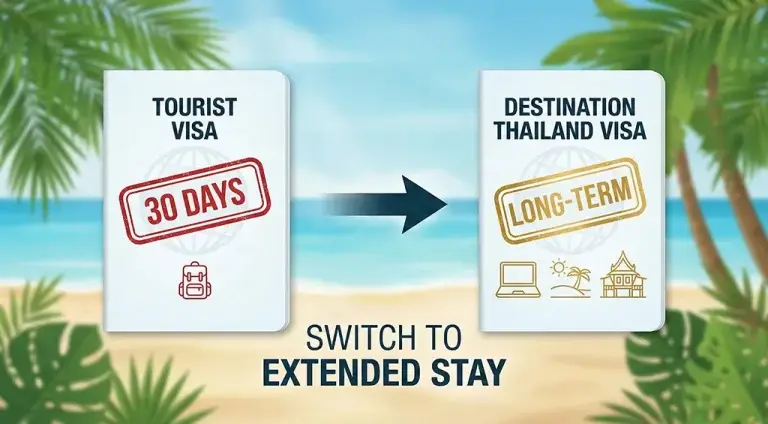
If you are currently in Thailand on a tourist visa, you may find that short stays are not compatible with longer-term plans. This is often the case for people who work remotely, participate in activities such as Muay Thai training, or sign up for cultural or wellness programs.
The Destination Thailand Visa (DTV) offers a longer and more flexible option. It is valid for 5 years, allows multiple entries, and permits a stay of up to 180 days per entry. Each stay can be extended once for another 180 days, allowing you to stay in Thailand for a total of up to 360 days at a time.
The following sections explain how to switch from a Thai tourist visa to a Thai travel visa.
Is it possible to switch to DVB-T within Thailand?
No. You cannot apply for the Destination Thailand Visa (DTV) while you are in Thailand. All applications must be submitted while you are physically outside the country. Applications submitted within Thailand will not be accepted. However, you can prepare your documents in advance while in Thailand and submit your application after you have left the country.
What happens after your DTV application is approved?
Once your Destination Thailand Visa (DTV) is approved, you can use the visa for long-term stays in Thailand under the following conditions:
Step-by-step instructions for switching to DTV
To switch from a Thai tourist visa to a Destination Thailand visa (DTV) in 2026, you can follow these steps:
Step 1: Leave Thailand before your current stay expires.
You must leave Thailand before your approved stay expires. Overstaying your visa may affect future visa applications or re-entry.
Step 2: Travel to another country
You must be physically located outside of Thailand to apply. Many applicants choose nearby countries like Laos, Malaysia, or Vietnam, but you can also apply from your country of residence.
Step 3: Submit your application
Submit your application through the official Thai e-Visa website. You must select the Thai embassy or consulate in the country where you are currently located.
Step 4: Wait for processing.
Processing times typically range between 5 and 20 working days, depending on the embassy or consulate.
You should remain in the country where you applied during this period, as additional documents or an interview may be required.
Step 5: Re-entry into Thailand
Once your application has been approved, you will receive your e-visa by email. You can then return to Thailand, where you will be granted a new stay of 180 days upon arrival.
Document checklist for the switch
Preparing your documents early can reduce delays or the risk of rejection. Requirements may vary depending on the embassy or consulate processing your application, so please refer to the most up-to-date guidelines for your location (as of 2026).
General requirements
Category-specific evidence:
Common mistakes to avoid
Avoiding the following points can help prevent delays, rejections, or penalties related to your Thailand visa (DTV) application:
Timetable for the transition until 2026
This guide will help you switch from a Thai Tourist Visa to a Destination Thailand Visa (DTV). It will assist you in preparing your documents, avoid overstaying your visa, and ensure you return to Thailand with the correct visa before your current stay expires.
How to get help with your application
Applying for a Thailand visa (DTV) independently can be difficult, and even minor errors can lead to delays or rejection. In many cases, embassies reject applications without providing a detailed explanation, requiring you to repeat the process.
With Siam Legal, you receive support from a team that is thoroughly familiar with the specific requirements and procedures of the various Thai embassies. The firm reviews your case, submits your application to the appropriate embassy, and prepares your documents in accordance with applicable standards.
Siam Legal can handle the entire application process for you, including submitting documents and answering any questions from the embassy. This helps avoid delays and common problems. Contact Siam Legal today to start your DTV visa application.




Community
Comments 0
Start the conversation.