How long does it take to obtain a US visa from Thailand?
For many Thais, a trip to the USA is an exciting prospect. But the journey begins with a crucial step: applying for a US visa in Thailand. While the process is straightforward, it requires understanding and patience. This article aims to provide you with the most important information.
Taiguo.Source date 5 min read
Adapted from ThaiEmbassy.com (Siam Legal). Any first-person experiences in this article belong to the original author.
For many Thais, a trip to the USA is an exciting experience. But the journey begins with a crucial step: applying for a US visa in Thailand. While the process is straightforward in principle, it requires understanding and patience. This article explains the procedure and individual steps of applying for a visa in Thailand, covering the different types of visas and the entire process.
Understanding the different types of US visas
The United States offers a variety of visa types, each designed for specific travel purposes. Each of these visas has its own requirements and processing times, which can vary depending on individual circumstances, the specifics of the application, and the current workload of the relevant U.S. embassy or consulate.
Visas available to Thai nationals include, among others:
B-1 Visitor Visa: This type of visa is suitable for Thai citizens who wish to visit the United States of America for business purposes.
B-2 Visitor Visa: Similar to the B-1 visa, but for people who wish to travel to the USA for tourist purposes, medical treatment or to visit family.
F-1 Student Visa: An educational visa that is ideal for Thai students who wish to study in the United States.
CR-1 Visa: A conditional residence visa designed for family reunification, allowing spouses of US citizens to live with their parents in the USA.
K-1 Fiancé(e) Visa: This visa type is ideal for a Thai fiancé(e) who is engaged to a US citizen to enter the United States for the purpose of marriage, provided that the marriage takes place within 90 days of entry.
K-2 Visa: A non-immigrant visa for accompanying children of a Thai fiancé(e) or spouse who currently holds a US visa.
K-3 Spouse Visa: A spousal visa intended for spouses of US citizens to live in the USA, usually while they are awaiting approval of their immigrant visa application.
IR-1 Visa: Designed for spouses of US citizens, it offers the possibility of permanent residence.
IR-2 Visa: Intended for unmarried children under 21 years of age who are close relatives of a US citizen.
Start of the visa application process
The US visa application process initially comprises several steps:
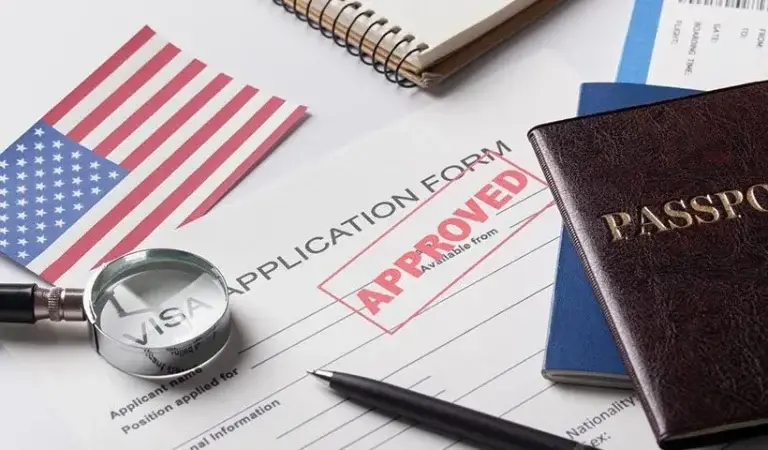
The first phase consists of completing the DS-160 form online, a comprehensive application that requires accurate and detailed information.
Applicants must then pay the required visa fee, the amount of which varies depending on the visa type.
Scheduling an interview at the US Embassy or Consulate in Thailand is the next crucial step. This requires careful planning, as appointments can fill up quickly, especially during peak travel season.
Applicants must compile all required documents, including a valid passport, recent photos in the specified format, and supporting documents relevant to the specific visa type, such as travel plans, letters of invitation, or proof of financial stability.
The interview process
The visa interview is a key part of the application process, as the consular officer verifies the applicant's eligibility for a visa. Applicants should conduct the interview honestly and clearly, answering the officer's questions straightforwardly.
The questions that applicants must answer include, among others:
The applicant's connections to Thailand
The financial resources to support the trip.
To avoid delays and increase the chances of approval, applicants should prepare carefully for the interview. Preparation often includes the following points:
Review of the application form
To fully understand the purpose and intention of the trip
The willingness to explain how this is compatible with the provisions of the visa applied for.
They should be prepared to demonstrate connections to Thailand, such as employment, family, or property, that prove their intention to return after their visit to the United States.
Processing times and factors that influence them
Processing times for US visas can vary significantly. Visitor visas (such as B-1/B-2) are often processed within a few days to a few weeks after the interview. Student visas (F-1), on the other hand, can take longer due to additional documentation and verification procedures.
Several factors influence processing times.
The number of applications received by the embassy or consulate can play an important role, with higher application numbers potentially leading to longer waiting times.
Seasonal peak periods, for example in summer or around important holidays, can also affect processing times.
Individual circumstances, such as the need for additional background checks or missing documents, may further extend the timeframe.
After the interview: approval, rejection, and administrative processing
Once the interview is completed, the application will either be approved, rejected, or subjected to administrative processing.
If the application is approved, the applicant will be informed about the visa application procedure.
In the event of a refusal, the consular officer will give a reason, which is usually related to criteria of US immigration law.
If your application undergoes an administrative review, a further assessment is required. This may extend the processing time, but does not necessarily mean a negative outcome. Applicants are advised to be patient during this time and to check the status of their application online.
Tips for a smooth US visa application process
To improve their chances, applicants should heed the following tips:
Make sure that all information on the DS-160 form is correct and complete.
Prepare all necessary documents and bring them to the interview.
Apply for the visa before your planned travel date to avoid possible delays.
Practice clear and honest communication during the job interview.
Regularly check the status of your application online for updates.
Diploma
Applying for a US visa from Thailand requires care and thorough preparation. Processing times can vary, but understanding each step and preparing accordingly can expedite the process. Patience and organization are essential, as is an open and honest approach to the application documents. These guidelines will help Thai citizens navigate the US visa application process more easily and confidently.
Contact Siam Legal
[column size='1/2']
LIVE SUPPORT
CALL
CHAT
Chat with our employee
From Thailand: Monday – Friday 4:00 – 18:00 (Bangkok time)
SourceThaiEmbassy.com (Siam Legal)
Contact
Let’s talk Thailand.
Tell us a little about what you have in mind. We’ll review your message and get back to you.
Community
Comments 0
Start the conversation.