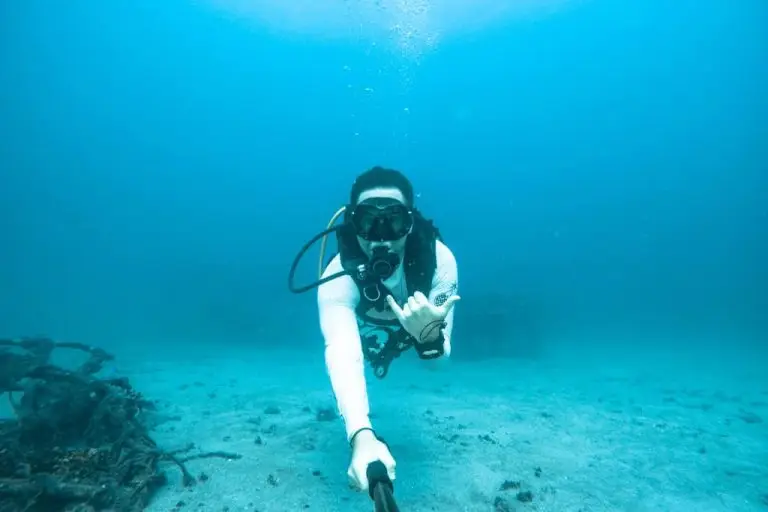
Travel writer Jarryd Salem, one half of the hugely popular travel blog team Nomadasaurus, recently revisited Koh Tao to learn more about the region's marine conservation programs and was inspired to take the ecological monitoring course offered by the local dive centre Black Turtle Dive.
Jarryd shares his experiences on the Nomadasauris blog – here's a little preview:
During my first visit to Koh Tao in 2014, I completed my PADI Rescue course as well as the wreck diving and Nitrox specialty courses to further improve my skills.
Having completed around 100 dives, I returned in 2023 to dive as much as possible and document my experiences while entering the world of nature conservation.
It's no secret that I love Koh Tao, and it was a great pleasure to return to the place that has almost become my home and give something back to the reefs.
I spent most of my time on this beautiful island taking the Koh Tao Ecological Monitoring Program (EMP) course with Black Turtle Dive, and it proved to be one of my most formative experiences since I first became a certified diver more than a decade ago.
Eventually, through my own experiences, I began to understand the importance of marine conservation and how I could make a meaningful contribution.
In this blog post, I will share my experiences with the EMP course in Koh Tao, what I learned, and how this course has forever changed my perspective as a diver.
Table of contents
The Ecological Monitoring Program (EMP) is a specialized diving course that focuses on the documentation and protection of marine ecosystems.
The course is offered by the non-profit organization Conservation Divers and is conducted exclusively in Thailand by the experienced team at Black Turtle Dive on Koh Tao. It teaches divers about the complex relationships within coral reef ecosystems, the identification of various marine species, and the techniques required for underwater exploration.
The ecological monitoring program is traditionally a 4-day course and combines practical diving skills with in-depth knowledge of marine biology and ecological monitoring techniques.
The aim is to equip divers with the necessary tools and understanding to effectively contribute to ongoing conservation efforts, not only on Koh Tao, but worldwide.
The data collected during these weekly reef surveys in Koh Tao are subsequently uploaded to a government-approved database so that scientists can track the condition of the reef over time.
I have since discovered that these are the same types of studies being conducted by marine biologists all over the world, including here in my home country, on Magnetic Island in the Great Barrier Reef.
It is an extremely useful and worthwhile course, and I was overjoyed to learn these skills.
Read Jarryd's full story here.
All images (c) Jarryd Salem
Community
Comments 0
Start the conversation.