Why should you go there and how do you do it right?
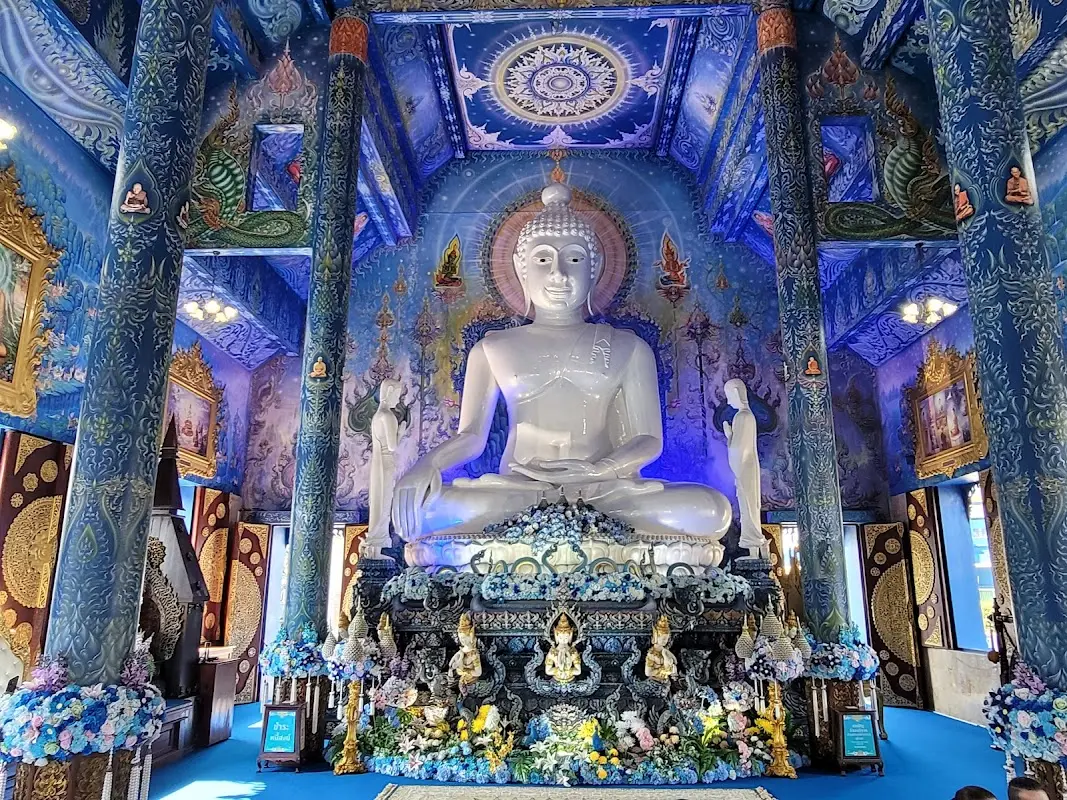
Blue is the dominant color here. Wat Rong Suea Ten, the Blue Temple, stands on the site of an abandoned temple in Rim Kok, about 3 km north of Chiang Rai's city center, across the Kok River. The main hall was built between 2005 and 2016 and is the work of local artist Phuttha Kabkaew, a student of Chalermchai Kositpipat, the creator of the White Temple. The family resemblance is unmistakable. Walls, ceilings, and pillars are deep sapphire blue and gilded, a large white Buddha sits enthroned at the far end of the hall, and blue Naga guardians line the steps. The name means "House of the Dancing Tiger" and refers to a local legend about tigers leaping across the river here.
Entry is free, though there is a donation box inside. This surprises many, as the White Temple has charged foreign visitors 200 baht since January 1, 2026. However, these are two separate temples by different artists, located about a 20-minute drive apart. The Blue Temple is open daily from 7:00 AM to 8:00 PM. Early morning and late afternoon offer a softer blue light and fewer visitors than midday.
Visitors report that photography is permitted inside the hall, unlike at the White Temple. However, as people come to pray, we ask that you be quiet and give way to those kneeling. Shoulders and knees should be covered, even for men, and shoes should be removed on the steps. If you arrive in shorts, you can borrow a sarong at the entrance. There are restrooms, souvenir and food stalls, and a few cats sleeping in the shade. The blue coconut ice cream sold on-site consistently receives high praise in reviews.
It's just a short drive from the city. Visitors report fares of 70 to 100 baht for a Grab or Bolt ride from the center and around 30 baht for a shared taxi (songthaew), while tuk-tuks are significantly more expensive. The Baan Dam is about 13 km north and the White Temple 13 km south, so the three temples can easily be visited from a hotel in Chiang Rai in two half-days.
Community
Comments 0
Start the conversation.