Follow the king's philosophy
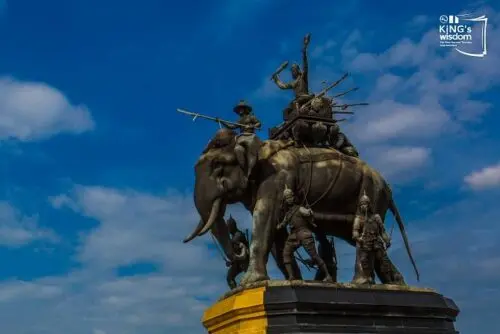
1 – Somdej Phra Suriyothai Monument
Makhamyong Monkey Cheeks Project under the royal initiative of King Rama IX.
The journey begins at the Somdej Phra Suriyothai Monument in the area of the Makhamyong Monkey Cheek Project, which is taking place under the royal initiative of King Rama IX.
During the reign of King Rama IX, Thung Makham Yong was used as part of the Monkey Cheek Project to prevent flooding from the north during the rainy season and to store water for the region's farmers during the dry season. This improved the livelihoods and well-being of the population. In 2011, the region was hit by the worst flooding in decades. The Monkey Cheeks played a vital role in mitigating the flood disaster.
Thung Makham Yong – Historical Recreation Area
It is a great blessing for the Thai people to experience the royal favor of King Rama IX. Besides the fact that Thung Makham Yong bears the name "Monkey Cheek Area" due to a royal initiative, this area also includes a statue of Somdej Phra Suriyothai, one and a half times the size of the real one, seated on the back of the royal elephant.
In addition, there are replicas of enemy camps and four enemy armies, reflecting the historical circumstances under which enemy armies were forced to retreat in this area during periods of high water. Adjacent to the reservoir are multi-purpose buildings and a park where visitors can relax amidst nature and enjoy the fresh air.
2 – Wat Niwet Thammaprawat
The only temple in Thailand built in the European style
Take the cable car across the Chao Phraya River. Visit a European-style Thai temple on an island in the middle of the Chao Phraya River, opposite Bang Pa-In Palace.
The first thing one notices is that the church differs significantly from Buddhist churches. During the reign of King Rama V, King Rama X commissioned the construction of a Gothic-style Christ Church. The church has a pointed spire, similar to a cathedral in Western architecture. A bell tower and carillon are located on the roof. Relics of the Buddha are also kept there.
Wat Niwet Thammaprawat, a royal temple of the Ratchaworawihan type belonging to the Dhammyuttika sect
Pay respect to the Buddha image “Phra Buddha Narumol Thammopas” – a Buddha image in the church that combines Western and traditional art.
Pay your respects to the Narumol Thammopas Buddha statue in the Ubosot. The statue, with its pure, gilded surface, measures 57 cm in width and 93 cm in height and was created by the master craftsman Phraworawongthae Phraongchao Praditaworakarn, blending traditional and Western stylistic elements, since the reign of King Rama IV.
The main image of Buddha is located in the base of the Chukchi church. The base resembles a church cross. The windows are arched. On the wall in front of the Buddha image is a portrait of King Rama V, adorned with stained-glass windows imported from Italy.
In the front area is the Buddha statue of Khan Than Rat, which stands before the ubosot. At the base of the Buddha statue is a stone inscription with the incantation and prayer for rain.
Phra Sri Mahapho, located at the corner of the glass wall in front of the Ubosot on the west side, is the tree that King Rama V brought from the city of Bodhgaya during the reign of King Rama IV.
The royal palace Krom Phraya Damrongrachanupab was built by King Rama V for Somdej Krom Phraya Damrong Rajanupab when he entered the monastic order at Wat Niwet Thammaprawat. During his time as a monk, Somdej Krom Phraya Damrong Rajanupab worked on a textbook for the Thai language entitled "Rapid Learning Textbook," thus developing a new curriculum for the first time.
An unusual and beautiful rock garden is the Disakunanusorn Stone Garden Cemetery, which contains the Phra Auti of Somdej Krom Phraya Damrong Rajanupab and Achi Ratchasakuldisakun.
Travel to Wat Niwet Thammaprawat
Getting to Wat Niwet Thammaprawat: Take the cable car across the Chao Phraya River to Wat Niwet Thammaprawat. Open daily from 5:30 am to 9:00 pm. • Address: Wat Niwet Thammaprawat, Bang Len Subdistrict, Bang Pa-in District, Phra Nakhon Si Province, Ayutthaya. • Opening hours: 9:00 am–5:00 pm (Monday–Friday) and 8:00 am–6:00 pm (Saturday–Sunday).
3 – Ko Gerd Community
Thai Wisdom Learning Center – Simple Community on the Chao Phraya River
End your journey through the old city of Ayutthaya in the simple village of Ko Gerd on the banks of the Chao Phraya River. The inhabitants live peacefully and simply; most are farmers and follow the philosophy of sufficiency economics established by King Rama IX.
Thai Wisdom – Ko Gerd Community Products Learning Center
The village of Ko Gerd is not only peaceful and simple, but also full of smiles and warm hospitality. A learning center offers visitors the opportunity to share their knowledge and skills. Experience the local way of life and participate in their activities. Feel the charm of the village, especially during demonstrations of how to prepare rare Thai sweets like Khao Ya Koo, which are said to have existed even during Buddha's lifetime. This is the source of the village's much-lauded identity.
Ya Koo Snack and Rice Milk – Rare Thai Dessert Learning Center Unique Dessert of the Ko Gerd Community
Ya Koo rice milk is made from soft grain rice and is characterized by a light aroma, a pleasant feeling of satiety, and good digestibility. It is rich in valuable nutrients, strengthens the immune system, reduces bloating, promotes digestion, and is low in fat and cholesterol-free.
Preparation of the Ya Koo snack – a unique dessert of the community
In addition, Aunt Lamphun also offers Thai wisdom physiotherapy in her house.
Show respect to the monks and visit the ancient temples dating back to the Ayutthaya period. Center of Buddhist faith – Ko Gerd Community
Visitors can take the tram or a bicycle to pay their respects to the Buddha image “Luang Pho Dam” at Wat Phaya, the sacred Buddha image from the Ayutthaya period.
Wat Phayayat, also known as Wat Nok, was the first temple built in the community since the Ayutthaya period around 2100 CE (Buddhist era) and is located on the banks of the Chao Phraya River. Inside the viharn is Luang Pho Dam (Pak Daeng), an ancient Buddha statue from the Ayutthaya period.
Wat Choeng Tha, an ancient temple dating back to the Ayutthaya period, is situated on the banks of the Chao Phraya River. Inside the temple is a Buddha statue over 100 years old, which was discovered in the Chao Phraya River in front of the temple in 2014. Numerous large Bodhi and Takhian trees, the Chao Mae Takian Shrine, and the monument to King Taksin the Great stand along the waterfront in front of the temple.
Ko Gerd Homestay Ayutthaya – Clean accommodation, relaxing atmosphere, warm and uncomplicated community
Ecotourism, Experience the daily life of the community – Learn about traditions and cultures – Ko Gerd, Ayutthaya Province
• Giving alms to the monks in the morning. • Day trip to the village. • Participation in community activities. • Learning local knowledge, e.g., the preparation of Thai medicinal herbs and traditional Thai desserts such as Khao Ya Koo, Khanom Kong, Samklaw, Kalamee, and crispy noodles. • Cycling, visiting the Buddha statue, and touring the Ayutthaya-era temples Wat Phayayat and Wat Choeng Tha. • Observing nature, e.g., during rice cultivation. • Taking a boat trip and experiencing the lifestyle of the people along the Chao Phraya River. • Dancing traditional dances with the youth. • Sharing diverse knowledge with community members and study participants.
• Take a boat trip and learn about the way of life of the people in the Chao Phraya River basin. • Take a boat trip and watch the local fishermen at work (river shrimp fishing). • Small and large boats, as well as a tram, are available for tourists.
• Take a boat trip on the Chao Phraya River to Wat Niwet Thammaprawat or take the tram to the Ko Gerd Arts and Crafts Centre.
OTOP products
• Khao Ya Koo • Herbal Bolus • Miniature Products • Khanom Kong • Kalamae




Community
Comments 0
Start the conversation.